
Sunday, October 31, 2010

Friday, October 29, 2010
Three Things You Can Do To Make Your Community Pit Bull Friendly

•Free vaccinations and microchip
•Free ear cleaning and nail trimming
•Free leashes and collars for first 300 dogs
•Free toys and treats for first 300 dogs
•Free dog food
Everything went! What a great day. These kind of events make the point against mandatory spay / neuter laws…no law required…if you provide low cost or free s/n services, they will come. But I digress.

Why all the attention on pit bulls? Well, for a variety of reasons, they are the most killed breed/type of dog in America’s shelters. If we want to get to No More Homeless Pets, pits are an essential piece of the puzzle.
Pit Bulls rock! They are remarkable, eager to please, animals with mad athletic skills and an abundance of personality. Of course you can make them fight, you make them do just about anything…including make coffee, but what they’re best at is being ridiculous… big grins, a motor driven tail and goofy poses and expressions.
Best Friends is committed to restoring the reputation of pit bull type dogs and has some exciting programs in the works featuring very effective tools and resources to help keep your community pit bull friendly.
At the No More Homeless Pets Conference 10 days ago, we were delighted to announce a partnership with Petsmart Charities called the “Shelter Partners for Pit Bulls Project”. Basically it’s a pilot project based on a very successful partnership between Best Friends and Salt Lake County Animal Services. It’s had a demonstrable impact on increasing the number of pit type dogs adopted and consequently reducing the number of such dogs surrendered and killed at Salt Lake County Animal Services.
Petsmart kicked in $240,000 to get the program started in 5 target communities that Best Friends will partner with: Rancho Cucamonga, California, Baltimore, Maryland, Washington, D.C., Carlsbad, California and Tampa, Florida.

All great stuff you say, but what can I do in my city to make it Pit Bull friendly?
Here are three things you can do to keep your community Pit Bull friendly:
Does your community have a comprehensive dangerous dog ordinance? If not, don’t wait, take steps to get a good one passed. It will be a bulwark against regressive and reactive breed bans or other breed discriminatory regulations. A good dangerous dog ordinance targets the deed, not the breed. It focuses on irresponsible owners of whatever breed of dog who encourage aggressive behavior, take pleasure in having the “baddest dog” in the neighborhood, blow off neighbors concerns and turn their dogs into extensions of their own anti-social selves with the result being that when, not if, someone gets bitten, the dog and probably the breed get blamed. Best Friends has model dangerous dog ordinance language available and our team will be happy to help shepherd you through the process of working with local officials to get good laws in place before bad laws are dreamed up by grandstanding and / or uninformed politicians. Click here for model ordinances, resources and more.
2. Use The Best Friends Breed Discriminatory Fiscal Impact Calculator
If your community is plagued by a grandstanding pol or has a well meaning but uninformed neighborhood activist or for some other reason is considering a breed ban or some other form of breed discriminatory legislation, the best strategy to move the conversation from fear mongering hysteria to a rational discussion of what’s best for the community, use THE CALCULATOR! The Best Friends BDL Fiscal Impact Calculator will tell you how much it will cost the taxpayer to enforce, defend and implement a breed ban. When dollars come into the conversation, everything slows down and the reality of a breed ban can be considered in a different light. Does your community really want to introduce a police state with door-to-door searches that leaves kids crying on the doorstep as family pets…family members…are hauled off to be killed or does it really want to protect the community and promote responsible pet ownership through proactive enforcement of progressive dangerous dog laws.
3. Host A Pit Bull Palooza
Have some fun, fix some pits, create a community of pit bull advocates who love these dogs and are sending all the right messages.
Pits are great dogs and they need our help to get out of shelters, to stay out of shelters and to be recognized for the great dogs that they are. For help and resources for your community be sure to visit the Best Friends campaign site for Pit Bulls: Saving America’s Dog.
By Francis Battista
Article found here.
Wednesday, October 27, 2010
Pit Bull Owners Take a Stand for Their Dogs
We've all heard the stereotypes: only criminals own pit bulls, people only want these dogs to fight them, pit bull owners don't care about their dogs.
And we all know where these stereotypes lead: to pit bull-type dogs facing unfair restrictions and bans, innocent dogs not getting a fair shot at adoption, and thousands of animals killed by shelters just because they look a certain way.
The best way to break stereotypes is to shatter them with reality. Everyone who lives with a pit bull knows this; we've all converted friends and family who abandoned their media-generated fears once they spent a little time up close and personal with our dogs. Many of them went on to adopt their own pit bulls.
And that's why Pit Bull Rescue Central created the "I Own a Pit Bull" campaign. It's time for pit bull owners to stand proud and dispel all those myths about pit bulls and the people who share their lives with them.
When cities, like Denver, pass breed specific legislation, they think they're targeting the drug dealers and other criminals in their town; people too busy breaking the law to go to the polls. Because it's proven again and again that knee-jerk policies targeting dogs based on breed don't reduce dog bites or reach irresponsible pet owners.
City officials don't imagine that they're profiling the small business owners, doctors, nurses, veterinarians, artists, computer programmers, teachers, waitresses, neighborhood watch coordinators, community volunteers ... but that's who's impacted whenever laws are passed that judge a dog based on his appearance, and not his individual actions and the irresponsibility of his owner.
So, now through tomorrow, October 23, use your Facebook status to stand up for your dog and show that you're not a stereotype. The formula is easy, and PBRC gives a few handy examples: I own a pit bull and I vote Green Party; I own a pit bull and I am a cancer survivor; I own a pit bull and I need coffee to get going in the morning. PBRC also provides a template for "I Own a Pit Bull" business cards that you can hand out. If you don't have a pit bull, use your status to show that people who love pit bulls and support their owners come from all walks of life, too.
Why now? Saturday, October 23, is National Pit Bull Awareness Day. At events across the country, pit bull owners, rescuers and advocates will be setting the record straight, promoting responsible pit bull ownership and showing their communities how fantastic these dogs are. I encourage everyone to check out the events in your community, and do your part to start changing minds.
Breed profiling is nothing new. Bloodhounds, Dobermans, German shepherds, and Rottweilers have all that their day. But the prejudice against pit bulls is unprecedented. The constant, widespread access to media reports of "pit bull attacks" (regardless of whether the dog was actually a pit bull or whether there was actually an attack) has kept the fear alive, and every day, responsible pit bull owners face new threats of breed specific legislation.
The only way out of this cycle is education, not only about the misconceptions about these dogs and the failings of breed specific legislation, but also about who we are.
Sunday, October 24, 2010

Saturday, October 23, 2010
National Pit Bull Awareness Day!

The National Pit Bull Awareness campaign is a nationwide effort to bring positive awareness and attention to the American Pit Bull Terrier and their responsible owners.
To anyone who shares their life with a "pit bull," the need for a national day of awareness for these misunderstood dogs is clear. Constant negative media attention and sensationalized hype that surrounds pit bulls has the breed in the spotlight for all the wrong reasons. The media and public have stereotyped and judged an entire group of dogs, as well as their owners, based on the actions of a few.
National Pit Bull Awareness Day was established as a day to educate and foster positive communications and experiences in the communities in which we and our dogs live. It is a day to focus on these incredible dogs and their devoted, responsible owners. A day to change perceptions and stereotypes.
The Pit Bull may be one of the most misunderstood animals in our country. For those of us who know this type of dog, we understand them to be incredible animals and great pets.
I cannot recall a single type of dog that has caused as much hype and hysteria as the Pit Bull. I say "type" because the Pit Bull is really not a breed but rather a moniker applied to several breeds with similar characteristics: American Staffordshire Terrier, Staffordshire Bull Terrier, American Bull Terrier and American Bulldog.
For responsible Pit Bull owners, we know these dogs to be loving, loyal, gentle companions that enrich our lives as much as we enrich theirs. We can relate to the "nanny dog" character, Petey (of Little Rascals fame), and see in our beloved pet the honor and courage of Sgt. Stubby, and of course the resilience and strength of heart of the now infamous Vick dogs. We are also constantly haunted by the threat of Breed Specific Legislation.
It is for this reason that responsible Pit Bull owners need to take the opportunity to join other responsible Pit Bull owners and organizations in supporting National Pit Bull Awareness Day.
On this day and every day it is imperative that we showcase our dog ambassadors at their best. Get involved with organizations that support education and programs to allow your "ambassadog" to interact with the public in positive ways.
Is your dog an AKC Canine Good Citizen? If not, make that your goal to gain CGC certification for the benefit of helping to minimize the negative public perception of your companion and to get some additional benefits from the AKC.
What do you know about Breed Specific Legislation? Educate yourself on the issues surrounding BSL, where BSL is enacted and how to get involved with fighting BSL in favor of more fair legislation that seeks to punish irresponsible dog owners rather than the dog.
And have a happy, safe National Pit Bull Awareness Day!
Article from:
http://www.chicagonow.com/blogs/dog-saving-network/2010/10/pit-bull-awareness-day.html
and
http://www.blessthebullys.com/national_pit_bull_awareness_day.html
What are YOU going to do to celebrate??
Find a pit bull event near you or volunteer at a local animal shelter!
Thursday, October 21, 2010
Wednesday, October 20, 2010
Tuesday, October 19, 2010
York SPCA Program Aims To Keep Pit Bulls Out Of The Pits
Not enough people see pit bulls for what they are -- loyal, intelligent and high-energy companions that need training and love, according to Melissa Smith, executive director of the York County SPCA.
And the endless flow of pit bulls into the SPCA's Emigsville shelter is what happens when people own the dogs for the wrong reasons, she said.
"Some people see pit bulls as a status symbol," Smith said, or a money-making venture. "The dogs are purchased for breeding, which is the last thing we need, but unfortunately there's a market for this. And some people obviously want the dogs for fighting."
That's why the York County SPCA is launching a program to help York's inner-city youths train their pit bulls and SPCA volunteer Ed Temple of Mount Wolf walks Tanner, a male pit bull. The SPCA is holding a program on Saturday, Oct. 23, to help pit bull owners. (John A. Pavoncello Photo)learn to see them as companions, she said. The program is even open to city youths who don't own dogs, because the SPCA can provide shelter pit bulls for dog-less youths.
The program kicks off at 10 a.m. Saturday, Oct. 23, at Sovereign Bank Stadium, in conjunction with National Pit Bull Awareness Day. People are encouraged to take their pit bulls to the stadium, where they can receive free rabies shots and microchipping, and celebrate the pit bull breed, Smith said.
Plenty of freebies: The SPCA will also hand out free dog food to owners who need it, and people can sign up their dogs for free spaying or neutering as well as the new youth training program, she said. Pit Bull Awareness Day festivities will continue that day at the shelter from noon to 4 p.m.
The first youth-pit bull training class will be held Nov. 6 at the Princess Street Center, Smith said. The SPCA is targeting middle-school students for the program, she said, but won't exclude older kids.
"Pit bulls get a really bad rap and aren't treated the same way as other companion dogs are treated," she said. "We need to change public perception of these dogs."
Smith said she got the idea from the Humane Society of the United States' "Keep Your Pet Out of the Pit" program. "Pit" means dog-fighting pit.
"Our target group is youth, because if we can get to them early enough, we can get them to see pit bulls as companion animals, as they should be seen," she said.
Good for kids, too: Smith said the SPCA is inviting at-risk youths to join the program as well. In addition to training and socializing the dogs, the program could help bolster youths' self-esteem and sense of responsibility, she said.
The SPCA chose York City for the training because of the high concentration of pit bulls there and is partnering with the city's Recreation and Parks Bureau, which is providing usage of the Princess Street Center.
"We just think it's a wonderful program, to educate and change the views on pit bulls," bureau director Tom Landis said.
The training program will help youths teach their pit bulls basic obedience and good manners, Smith said, and eventually could be expanded to include other dog activities, such as agility training.
"The goal is really to build the bond between a young person and a dog, and to make young people see what great family dogs pit bulls can be with proper training and socialization."
The numbers: Currently, the shelter has 132 dogs, more than half of which are pit bulls, Smith said. She called that ratio normal.
Since January, the shelter has taken in 236 pit bulls, many of which came from York City, she said. The next most common breed seen at the shelter this year is the Labrador retriever, Smith said, with 80 dogs so far.
Many of the pit bulls that come to the shelter are very friendly, but some have been treated badly and not properly socialized or trained, Smith said.
High-energy dogs: "That's what we're trying to avoid," she said. "Pit bulls are very loyal, very intelligent. But having said that, a pit bull owner needs to understand their dog's tenacity and steer that trait in the right direction. They have a lot of energy and they want to please their owners."
That means plenty of exercise and direction, she said.
A pit bull's natural trait of being protective of its family has resulted in people exploiting the breed, she said.
"And that's very sad, because pit bulls will go to the ends of the earth for their owners," she said.
Author: Elizabeth Evans
Watch a video at the website:
http://www.yorkdispatch.com/ci_16347412
Wednesday, October 13, 2010
Pit Proud: The History Of The Pit Bull
I’ve been working on Pit Proud: The History Of The Pit Bull for well over a year. But I believe that every second that went into it was worth it, because I knew then and I know now that Pit Proud is the single, most important Dog Files Episode yet.
It’s the story of what I believe to be, the most maligned and abused animal on Planet Earth.
The Pit Bull.
A dog that the media has made out to be the “great white shark” of the land. A monster waiting to jump out of the shadows and attack your children.
But you know what I’ve found out over the course of researching, writing and crafting this episode?
Pit Bulls… are just dogs. No more, no less.
And like all dogs, they are individuals with individual personalities and temperaments. But because of their intense loyalty and strong form, the pit bull has been singled out amongst lesser men to abuse and kill for their small-minded, cruel entertainment.
You see, the pit bull problem isn’t the dogs, by any means.
The pit bull problem is people.
The people that want to fight them. The people who want them so they feel tougher when they walk down the street. The people that keep them tied up in chains. The people who go about their days and weeks and months and years while ignoring the extremely social animal that’s locked up in their basement.
These are the irresponsible owners that should never own ANY dog. And these are the people that we should always have on our radar.
And the abused dogs?
Well, if the Vick case taught us anything, it’s that even fight dogs, when given a chance, would rather curl up on the couch next to it’s loving human.
And that says it all to me. Pit Bulls are dogs. Dogs are as individual as any human. And like humans, they shouldn’t be painted with a wide brush.
Unless that wide brush has peanut butter on it. I hear pit’s LOVE peanut butter.
– Kenn Bell, Dog Files Creator
http://www.thedogfiles.com/2010/10/11/pit-proud-the-history-of-the-pit-bull/
After a Rocky Past, Zeus is Living Like a King

Zeus is an American bulldog and pit bull mix. His story of life as a stray on the streets to adoption reads like a fairy tale; the one about the damsel in distress who winds up being rescued by a knight in shining armor atop a white horse.
While Zeus isn’t a damsel, he definitely was in distress. Reported wandering the street of Salt Lake City, Utah, Zeus was apprehended by an animal control officer for Salt Lake County Animal Services. Like so many other dogs listed as RAL (running at large), he had no identification and was brought to the shelter to await redemption by his person. He was alone and given identification number A340150.
Nobody came to claim Zeus and after waiting the requisite five business days, he began the evaluation process. The temperament test on Zeus (initially named McCloud by the staff) went very well. According to notes in his file, one by shelter operations manager April Harris read, “This dog passed assessment with A's and B's on the entire assessment. This is one sweet, mellow, affectionate, AMAZING dog!” (Remember the word amazing.)
Other evaluations were just as positive. Another person noted, “Took out for a walk; he is a sweetheart. He does not pull on the leash and is definitely housetrained. When he comes across other dogs, he does not bark. He just wags his tail and appears to be eager to meet them. He loves to play and will play with toys if they are available for a short time but he prefers to cuddle.”
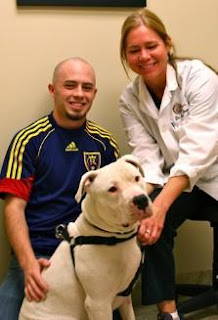
To make matters worse, Zeus had a condition that was a deal breaker for the five or six potential adopters who showed interest. Zeus suffered from entropion, a condition where the eyelid rolls inward and which needed to be addressed surgically. Surgery to correct this condition could easily have tacked on $1,500 to his adoption fee and would need to be paid by the adopting party.
Enter our “knight in shining armor,” Phil Walker. Walker had been looking for a dog to adopt for a couple of years, but never lived where dogs were allowed — until now. Not only did his new apartment allow dogs, but Walker’s landlord accompanied him on his search for a dog to adopt.
The first stop was Salt Lake County Animal Services where Walker and his new landlord carefully scrutinized the dogs available for adoption.
“There were a couple dogs that I thought I might like to take home, but none really jumped out at me,” recalls Walker. “As we were about to leave, one of the shelter employees was bringing Zeus in from a meet and greet outside and I did a total double-take. I thought he just looked, for lack of a better word, amazing.” (There’s that word amazing again!)
Walker studied Zeus as he sat quietly in his kennel. “I went over to his kennel and he just sat there, calm as could be, leaning up against the door, just wanting to be petted. I know it's cheesy, but it was a complete movie moment. I fell in love with him immediately.”
Not wanting to make a snap decision, Walker decided to think about it and scouted another shelter for a canine companion. As he looked at other adoptable dogs, he couldn’t get the image of Zeus out of his mind. “I decided right then and there Zeus was the dog for me.”
The adoption coordinator told Walker about Zeus’s eye problem and the required surgery he would have to take on. Walker needed a couple of days to think things through. “It was very hard.” said Walker. “I make a decent living, but I'm not at the point where I can spend possibly $1,500 on a dog. However, on Monday morning I decided to go through with it.” After all, knights in shining armor don’t give up.
When Walker returned to adopt Zeus, he was shocked to find Zeus gone. He was already undergoing much-needed surgery thanks to a second knight in shining armor, Melissa Lipani, the campaign coordinator for Best Friends’ campaign Pit Bulls: Saving America’s Dog.

“When I contacted Amy to see if she could help, she was immediately willing to look at him.” said Lipani. “The amazing staff at the Eye Care Center was willing to provide what he needed at their cost and donate their time, which was instrumental in obtaining what he needed since the shelter doesn't have a lot of resources for specialty surgeries. Dr. Knollinger, Dr. McLaren, and the administrative staff were so supportive and willing to help. We appreciate their specialty skills and their willingness to help McCloud so that he could move into a permanent, loving home.”
Dr. Knollinger operated twice on Zeus. Once to place skin staples to stabilize the eyelid and allow his corneal ulceration to heal and again to perform permanent cosmetic surgery once the ulceration healed. Zeus’s outlook is good. “Zeus responded nicely to surgery.” said Dr. Knollinger. “His long-term prognosis is great. He was a great patient to work with.”
Zeus has now finished his follow-up appointments to remove his stitches and examine his eyelid. He can now focus on being a dog enjoying a loving home.
“When we're hanging out, we generally play with his rope toy.” says Walker, recounting some of Zeus’s antics. “I’ll throw it and if he feels like it he'll bring it back to my general area. The funny thing is, he knows what I’m asking him to do, but he gets this look in his eyes as if to say, ‘Yeah, I know what you want but, you know, I don't really feel like it.’ He loves giving that rope the beating of its life every time we play.”

“One of the funniest things he does, for whatever random reason, is just take off around the yard, running as fast as he possibly can. And he'll just do laps around the yard. I have no idea what makes him do that or why, but he's just happy to be running sometimes.”
Most all dog people recognize this behavior as their dog’s way of saying, “I’m so happy to be here, comfortable in my surroundings, and knowing that I am loved that I just want to let my hair down and run.” Don’t you just love happy endings?
How you can help:
There are always plenty of wonderful dogs at Salt Lake County Animal Services. Check out some of their adoptable pit bull terriers.
Learn more about the Pit Crew.
Best Friends Animal Society is working throughout the country to help pit bull terriers, who are battling everything from a media-driven bad reputation to ineffective and expensive legislation. Best Friends hopes to end discrimination against all dogs. Dogs are individuals and should be treated as individuals. Find out how you can help by visiting and becoming a fan of the Pit Bulls: Saving America's Dog campaign.
Join Voices for No More Homeless Pets and for updates on animal issues important to you!
Learn more about breed bans and dog bite facts at the National Canine Research Council.
Find more resources in our Tools To Use section.
FREE ACTION KIT DOWNLOAD
"How to Prevent Breed Discrimination in Your Community"
Photos by Ken Passarella
By Ken Passarella, Best Friends Network volunteer
http://network.bestfriends.org/campaigns/pitbulls/16138/news.aspx
Sunday, October 10, 2010
Video du Jour
Behaviorist Karen Overall Calls Pit Bulls 'Incredibly Gentle Dogs'
Veterinary behaviorist Dr. Karen Overall, center for Neurobiology and Behavior University of Pennsylvania, talks about social structure of dogs, dominance myth, training methods and myths about Pit Bulls.
http://www.chicagonow.com/blogs/steve-dale-pet-world/2010/10/behaviorist-karen-overall-calls-pit-bulls-incredibly-gentle-dogs.html
Tuesday, October 5, 2010
Jean Donaldson Interview
Watch an interview with Jean Donaldson, a dog trainer and author with 35+ years of experience
Wednesday, September 29, 2010
Top 5 Myths about Pit Bulls

All pit bulls and other so-called “bully breeds” are aggressive.
Fact: Many people wrongly believe that pit bulls are aggressive toward people. Pit bulls were originally developed for fighting with other dogs—not people. In fact, there’s some evidence that pit bulls are actually less aggressive toward people than many other breeds. In tests conducted by the American Temperament Test Society, pit bulls had a passing rate of 82% or better -- compared to only 77% of the general dog population. Problems for the pit bull arose when these dogs gained the attention of people looking for a “macho” dog to meet their demands. Like any other breed of dog, pit bulls are shaped by their environment and, if not provided proper socialization and training, can be encouraged to show aggressiveness toward people. Pit bulls that exhibit aggressive behavior toward humans are not typical of the breed type.
Beyond a dog’s breed, factors that affect a dog’s tendency toward aggression include reproductive status, sex, early experience and socialization/training. According to the Centers for Disease Control, these concerns are well-founded, given that:
- More than 70 percent of all dog bite cases involve unneutered male dogs.
- An unneutered male dog is 2.6 times more likely to bite than is a neutered dog.
- A chained or tethered dog is 2.8 times more likely to bite than a dog not chained or tethered.
- 97 percent of dogs involved in fatal attacks on people in 2006 (the most recent year statistics are available) were not spayed/neutered.
Myth No. 2:
The term “bully breeds” indicates these dogs are inherently mean.
Fact: There are several breeds of dogs often referred to as bully breeds, including pit bulls, bulldogs, mastiffs, Staffordshire bull terriers, American Staffordshire terriers, Boxers and Bull terriers. The term does not refer to their behavior. It means they have bulldog origins and are descendants of the original English baiting dogs that were bred to grip and hold bulls, bears and other large animals. Modern dog-fighting can be traced to 1835, when bull-baiting was banned in England. After the ban, the owners of bulldogs turned to staging fights between their dogs, and the large, heavy bulldogs were bred with small, quick terriers to produce the dogs that became the fountainhead of today's prominent fighting breeds.

Pit bulls will attack without warning.
Fact: No dog, including a pit bull, is likely to transform from a docile, gentle companion to a ferocious beast without warning. There are always warning signs that the dog is aroused, upset or afraid in a particular situation. Perhaps the dog has had little exposure to children and is wary whenever he sees a child. Perhaps the dog spends his days tethered in the backyard, barking at people walking past the property. The dog’s pent-up frustration could result in an aggressive reaction, should a stranger wander into the yard and approach the dog. The issue is not that pit bulls attack without warning; it’s that often people don’t recognize or pay attention to the early warning signs. Check out the ASPCA’s Virtual Pet Behaviorist for useful information in understanding canine body language.
Myth No. 4:
It’s not safe to adopt a pit bull from a shelter because its past is unknown.
Fact: Although it’s always helpful to know the health and behavior history of a dog and its parents, there are wonderful dogs waiting to be adopted from shelters. And, often times, a shelter dog’s past is a mystery. Responsible shelters or rescue groups assess the dogs in their care so that they can avoid adopting out dogs with aggressive tendencies. And it’s the adopter’s responsibility to ask questions. Talk with the staff to learn if the dog has exhibited any undesirable behaviors. Adult dogs are open books -- from the start, you’ll know things like their full-grown size, personality, likes and dislikes, and grooming needs. Having a dog since puppyhood does not guarantee that it will have all of the qualities you desire when it grows up. The ASPCA encourages potential adopters of a pit bull or any dog to bring the whole family, including their current dogs, to meet the new dog.
Myth No. 5:
Banning pit bulls will help reduce dog bites and fatal attacks.
Fact: There is no evidence that breed-specific laws -- which are costly and difficult to enforce -- make communities safer for people or companion animals. Breed-specific legislation carries a host of negative and wholly unintended consequences. For example, irresponsible owners forgo licensing, micro-chipping and proper vet care -- all of which have implications for public safety and the health. Instead, friendly, properly supervised and well-socialized "bully dogs" and their owners are punished. Such laws also impart a false sense of security, because limited animal control resources are channeled into enforcing the ban rather than focusing on enforcement of non-breed-specific laws that have the best chance of making our communities safer, such as dog licensing, leash laws, animal fighting laws, and anti-tethering laws. Recognizing that the problem of dangerous dogs requires serious attention, the ASPCA seeks effective enforcement of breed-neutral laws that hold dog owners accountable for the actions of their animals. Click here for more information on pit bulls and their behavior.
Read more about the rehabilitation of Michael Vick's dogs...
By Pam Reid
Editor's note: Jim Gorant's story about the rehabilitation of Michael Vick's dogs in the Aug. 15 issue of PARADE prompted an online debate about the nature of pit bulls. Parade.com invited the American Society for the Prevention of Cruelty to Animals to address the most common perceptions -- and misperceptions -- about the breed.
Pam Reid, Ph.D., CAAB, is the Vice President of the ASPCA's Animal Behavior Center.
Article from: http://www.parade.com/news/2010/09/03-pit-bull-myths.html
Wednesday, September 22, 2010
Pit Bulls: It's Not All in How They're Raised
Nothing has brought the debate of Nature vs. Nurture to the mainstream quite like pit bulls have. People who say, "it's all in how you raise them," are well-intentioned, wanting to help these dogs overcome an undeserved bad rap, and I appreciate that. But they're wrong.
If you're standing firm on the Nurture side of the debate, riddle me this: If it's all in how they're raised, how is it that dogs who have spent their lives with dog fighters are now living happily as family dogs, in multiple-pet households, and as therapy dogs? How is it that one of my own pit bulls, rescued as a senior dog from an abusive hoarder, went on to be a breed ambassador at public events, even helping girl scouts earn their pet care badge? These pit bulls weren't raised according to the recipe for a good dog.
Here's where people get it backwards: It doesn't take a good person to raise a good pit bull; it takes a very, very bad person to raise a bad pit bull.
Which brings us to the Nature side of the equation. Year after year, standardized temperament tests show that the breeds commonly considered "pit bulls" score above average compared to all other breeds. And anyone who claims "pit bulls bite more than any other breed," apparently knows something the Centers for Disease Control and Prevention doesn't. The CDC states: "There is currently no accurate way to identify the number of dogs of a particular breed, and consequently no measure to determine which breeds are more likely to bite or kill."
There is no scientific evidence proving that pit bull type dogs are more "dangerous" than any other dog. (Newsflash for anyone getting their information from the media: The media reports what it wants, how it wants. What sells papers isn't an accurate reflection of reality.)
People often point to the dog fighting heritage as proof that pit bulls are "aggressive." This is one area where Nature and Nurture agree: willingness to fight other dogs has nothing to do with attitudes toward humans. It's also illogical — dogs bred to be champion fighters were among the most gentle toward humans; bites weren't tolerated. Dog fighters want to hurt their animals, not themselves.
Does this mean Nature wins? Not really. As with any breed, seriously abused animals may bite back. On the flipside, compassion and rehabilitation can go a long way toward rebuilding trust.
That's true for every animal (including humans). Pit bulls are canis familiaris, just like any other dog, and they should be judged on their behavior, just like any other dog, regardless of what they look like or what they've been through.
Bottom line: All dogs are individuals.
Does this mean everyone should run out and adopt a pit bull? Of course not. There's no one type of dog that's the perfect match for every person and every lifestyle.
Pit bull type dogs are strong and full of personality. Some are energetic and tenacious (though mine are mostly driven to get a good spot on the couch), most are intelligent, and almost all are loyal ... almost to a fault, which is why they're such easy targets for dog fighters and other abusers. Some pit bulls don't like other dogs. But, others, like my own, love their canine housemates. (Meanwhile, my parents' purebred standard poodle has been dog-aggressive since she was 12 weeks old).
Perhaps most importantly, pit bull people have a responsibility to be good breed ambassadors, the best dog owners out there, to avoid feeding media trolls and misconceptions.
So, if you're up to the challenge of defying discrimination and bringing a goofy, loving dog into your home, there are a lot of pit bulls out there who need you.

Photo credit: Amanda Clase
Article from:
http://animals.change.org/blog/view/pit_bulls_its_not_all_in_how_theyre_raised#share_source=blog-top_fb
If you're standing firm on the Nurture side of the debate, riddle me this: If it's all in how they're raised, how is it that dogs who have spent their lives with dog fighters are now living happily as family dogs, in multiple-pet households, and as therapy dogs? How is it that one of my own pit bulls, rescued as a senior dog from an abusive hoarder, went on to be a breed ambassador at public events, even helping girl scouts earn their pet care badge? These pit bulls weren't raised according to the recipe for a good dog.
Here's where people get it backwards: It doesn't take a good person to raise a good pit bull; it takes a very, very bad person to raise a bad pit bull.
Which brings us to the Nature side of the equation. Year after year, standardized temperament tests show that the breeds commonly considered "pit bulls" score above average compared to all other breeds. And anyone who claims "pit bulls bite more than any other breed," apparently knows something the Centers for Disease Control and Prevention doesn't. The CDC states: "There is currently no accurate way to identify the number of dogs of a particular breed, and consequently no measure to determine which breeds are more likely to bite or kill."
There is no scientific evidence proving that pit bull type dogs are more "dangerous" than any other dog. (Newsflash for anyone getting their information from the media: The media reports what it wants, how it wants. What sells papers isn't an accurate reflection of reality.)
People often point to the dog fighting heritage as proof that pit bulls are "aggressive." This is one area where Nature and Nurture agree: willingness to fight other dogs has nothing to do with attitudes toward humans. It's also illogical — dogs bred to be champion fighters were among the most gentle toward humans; bites weren't tolerated. Dog fighters want to hurt their animals, not themselves.
Does this mean Nature wins? Not really. As with any breed, seriously abused animals may bite back. On the flipside, compassion and rehabilitation can go a long way toward rebuilding trust.
That's true for every animal (including humans). Pit bulls are canis familiaris, just like any other dog, and they should be judged on their behavior, just like any other dog, regardless of what they look like or what they've been through.
Bottom line: All dogs are individuals.
Does this mean everyone should run out and adopt a pit bull? Of course not. There's no one type of dog that's the perfect match for every person and every lifestyle.
Pit bull type dogs are strong and full of personality. Some are energetic and tenacious (though mine are mostly driven to get a good spot on the couch), most are intelligent, and almost all are loyal ... almost to a fault, which is why they're such easy targets for dog fighters and other abusers. Some pit bulls don't like other dogs. But, others, like my own, love their canine housemates. (Meanwhile, my parents' purebred standard poodle has been dog-aggressive since she was 12 weeks old).
Perhaps most importantly, pit bull people have a responsibility to be good breed ambassadors, the best dog owners out there, to avoid feeding media trolls and misconceptions.
So, if you're up to the challenge of defying discrimination and bringing a goofy, loving dog into your home, there are a lot of pit bulls out there who need you.

Like Sophie, a petite, sensitive pit bull rescued last summer in the largest dog fight bust in U.S. history. Her foster mom has had the joy of watching her rediscover life and love, describing her as a "natural born clown." To learn more about Sophie, or search for adopt-a-bull dogs in your area, visit Pit Bull Rescue Central.
Photo credit: Amanda Clase
Article from:
http://animals.change.org/blog/view/pit_bulls_its_not_all_in_how_theyre_raised#share_source=blog-top_fb
Tuesday, September 21, 2010
Pit Bulls and Chocolate

vegan chocolates benefitting animal-rescue groups.
Gross loves her Mocha. And we don’t just mean chocolate — although she loves that, too. Mocha is the name of Gross’s 2½-year-old pit bull, a rescue dog who went from the streets of The Bronx to appearing on the label of a chocolate bar called Peanut Butter Pit Bull.
Funnily enough, the small pit bull with the cropped ears already had the name when Gross adopted her through New Hope, the rescue arm of the Animal Care & Control of New York City, but it was pitch-perfect for the pet of a self-confessed chocoholic.
“I was smitten,” says Gross of the time she first saw Mocha’s photo on a friend’s Facebook page. “Her eyes stuck with me.” The feeling only intensified when she arranged to meet the young dog near Central Park. “She was just all love. I couldn’t resist.”
Sarah Gross’s rescued pit bull Mocha inspired her to market vegan chocolates benefitting animal-rescue groups.
She adopted the dog soon after, and as Mocha settled into her new life in Park Slope, Gross, 25, set about exploring her other irresistible passion: chocolate.
She had always had a sweet tooth, but a couple of years ago, when she moved to New York, she actually found herself living the Willy Wonka dream with a part-time job in a chocolate factory. While working for Gnosis Chocolate, an organic, vegan and kosher line of sweets based in Queens, she helped create a best-selling flavor. After hours, she roamed New York looking for even more vegan-friendly options.
“I thought, ‘I’m going to try every vegan chocolate I can find,’” says Gross, who sampled Russian chocolate in Brighton Beach and Polish chocolate in Greenpoint.
The plans for her own chocolate line would never have come to life, though, if it weren’t for Mocha. One cold morning last December, Gross had a piece of dark chocolate for breakfast and then headed out to walk her pooch. With the sugar surging through her system, it hit her: Why not combine her two loves by starting her own line of vegan chocolates and donating the profits to rescue groups, like the one that had brought Mocha into her life?
Through her choc-world connections, Gross found a factory in Red Hook to make chocolate to her specifications, and in January she launched Rescue Chocolate (rescuechocolate.com). The all-vegan line offers chocolates in five flavors, including “Peanut Butter Pit Bull” (with crispy peanut butter) and “Foster-iffic Peppermint” (with crunchy cacao nibs) at $5 a pop. Each month, Gross donates Rescue Chocolate’s net profits to a different animal-rescue organization around the country.
Aside from appearing on the labels, Mocha’s job is to help promote her oft-maligned breed. “Pit bulls do take some understanding because they are strong,” admits Gross. “But if you train them and treat them well, they won’t be aggressive. [Mocha] is also a big snuggle-bug. My bed has become her throne.”
But even when she’s napping the afternoon away, Gross says, Mocha’s influence is always at work: “She’s my best friend, but also my ambassador. I want her to show people that pit bulls are really sweet.”
That and the chocolate, too!
http://www.rescuechocolate.com/
By REBECCA WALLWORK
Article from:
http://www.nypost.com/p/lifestyle/pets/chocolate_to_the_rescue_hyGaYDMPAQ4rEJkcU2zLTJ?sms_ss=facebook
Sunday, September 19, 2010
Thursday, September 16, 2010
Weela, the Pit Bull Lifesaver

Weela, Ken-L Ration's Dog Hero of the Year (1993)
Gary Watkins, eleven years old, was absorbed in chasing lizards when Weela, the family Pit Bull, plowed into him with a body slam that sent him sprawling. Gary's mother, Lori, saw the whole incident and remembers being surprised at first, because Weela always played kindly with children. But her surprise quickly turned to horror when she saw a rattlesnake sink its fangs into Weela's face. Somehow Weela had sensed the snake's presence from across the yard and rushed to push Gary out of striking range.
Luckily for thirty people, twenty-nine dogs, thirteen horses and a cat, Weela recovered from the snake's venom. Luckily, because that's how many lives she saved a few years later. For her heroism, Weela was named Ken-L Ration's Dog Hero of the Year in 1993. The press release read in part:
In January 1993, heavy rains caused a dam to break miles upstream on the Tijuana River, normally a narrow, three-foot wide river. Weela's rescue efforts began at a ranch that belonged to a friend of her owners, Lori and Daniel Watkins. Weela and the Watkinses worked for six hours battling heavy rains, strong currents and floating debris to reach the ranch and rescue their friend's twelve dogs.
From that experience, the Watkinses recognized Weela's extraordinary ability to sense quicksand, dangerous drop-offs and mud bogs. "She was constantly willing to put herself in dangerous situations," says Lori Watkins. "She always took the lead except to circle back if someone needed help."
Periodically, over a month's time, sixty-five pound Weela crossed the flooded river to bring food to seventeen dogs and puppies and one cat, all stranded on an island. Each trip she pulled thirty to fifty pounds of dog food that had been loaded into a harnessed backpack. The animals were finally evacuated on Valentine's Day.
On another occasion, Weela led a rescue team to thirteen horses stranded on a large manure pile completely surrounded by floodwaters. The rescue team successfully brought the horses to safe ground.
Finally, during one of Weela's trips back from delivering food to stranded animals, she came upon a group of thirty people who were attempting to cross the floodwaters. Weela, by barking and running back and forth, refused to allow them to cross at that point where the waters ran deep and fast. She then led the group to a shallower crossing upstream, where they safely crossed to the other side.
Strong, gentle intelligent and brave, Weela,CGC,TT, is the ultimate American Pit Bull terrier, epitomizing the best that the breed has to offer. But her story also highlights an important yet often misunderstood fact about the breed. The Pit Bull is a dog that loves to please its owner and tries to become whatever kind of dog its owner desires. Weela has had two owners.
The first owner dumped her in an alley to die when she was less than four weeks old. Her present owner, Lori Watkins, found five starving Pit Bull puppies whimpering in an alley, took them home and raised them. later, the Watkins family placed four of the puppies in loving homes and kept the little female they named Weela. They believed Weela was special, and she proved them right. Most Pit Bull puppies grow up to become a reflection of both their owners' personality and the care and training they receive. One can only imagine what a different dog Weela would have become if her original owner had raised her, and she had done her best to please him.
http://www.dontbullymybreed.com/Weela.php
Tuesday, September 14, 2010
ADOPT a Shelter Dog!

Why NOT to breed pit bulls:
Did you know that "Pit Bulls" are currently the number one bred dog in the United States? Ironically, they are also one of the hardest breeds to find homes. It is estimated that there is a current average of 3 million "Pit Bulls" living in the United States and only 1 in 600 will successfully find a "forever" home. Sadly, for every 1 "Pit Bull" placed in a loving home there are 599 killed. Shockingly, that statistic unfortunately does not exclude puppies!
Roughly 200 "Pit Bulls" are killed each day in Los Angeles alone because there are not enough homes for the ever-growing population of unwanted dogs in that area. This is a frustrating problem due to over-breeding either intentionally or accidentally. Either way you look at it, it comes down to irresponsible actions by irresponsible and or greedy humans. Many people may not realize that any dog not spayed or neutered is a potential contributor to this terrible problem. The average fertile dog can produce 2 litters in one year. The average number of puppies in a canine litter is 6-10. In six years, one female dog and her offspring can theoretically produce 67,000 dogs..many or most of which will end up dead.
There are between 4,000 and 6,000 animal shelters in the United States. The number of cats and dogs entering those shelters each year is roughly 6-8 million! However, only 30% of the dogs and 2%-5% of the cats are actually reclaimed by their owners. This means the total number of cats and dogs euthanized by shelters annually is 3-4 million! It is estimated that 1 million of those dogs are "Pit Bulls".
Shelters in large cities across the U.S. typically find themselves with a "Pit Bull" population of anywhere from 40% to 60% of the total shelter population and a national average of 33%. Many shelters needing more space will opt to euthanize "Pit Bulls" before any other type of dog due to this overwhelming number. 75% of shelters nationwide will euthanize all "Pit Bulls" entering the facility without ever giving them a chance to be adopted…some more lenient organizations may give the dogs a mere 24 hour grace period before administering the lethal injection. A study done by Animal People reports that the "Pit Bull" euthanasia rate in shelters is at approximately 93% on average which means that ultimately only 7% of all homeless "Pit Bulls" in America will find a "forever" home.
Surely you can see how over-breeding has negatively affected the lives of so many dogs. It is a fact that "Pit Bull" breeders are directly responsible for a significant percentage of the estimated 1 million "Pit Bulls" killed by euthanasia each year nationwide. Now I ask, why breed or buy while so many homeless dogs die?
The "Pit Bull" breeding trend will continue to impact this growing issue of overpopulation in America as long as Americans continue to buy "Pit Bulls". Start making a difference by adopting a "Pit Bull" at your local shelter or visit any one of the websites listed below to view thousands of wonderful, perfectly healthy dogs nationwide waiting to be adopted by a loving family. You can save a life and change these statistics one dog at a time!
Petfinder.com AdoptAPet.com PBRC.net
Information from:
http://www.pitbulladvocate101.com/NotBreed.php
Monday, September 13, 2010

Monday, September 6, 2010

Sunday, September 5, 2010
Therapy Dog Survives Fighting Ring, but Blood Sport Remains Active
The story of Daisy Mae the pit bull is like that of any other survivor-she suffered pain, got back on her feet, and is now living a sweeter, more meaningful life because of her experience.
Daisy Mae, formerly part of a dogfighting operation, is now a therapy dog in Santa Barbara making weekly rounds at Cottage Hospital’s pediatric ward and Villa Riviera retirement home. Gentle and affectionate, the three-year-old cuddles with the elderly and frail, and even allows small children to hold her tight when they are undergoing painful medical procedures.
Her miracle of rehabilitation mirrors that of the dogs rescued from the Michael Vick fight farm, where only one dog had to be euthanized for being vicious. Of the remaining 47 Vick canines, most have been placed in homes, many with children, other dogs, and cats.
While Daisy Mae and the rehabilitated Vick dogs are changing hearts and minds about the American pit bull terrier, dogfighting continues to be a dark and bloody reality in the United States. According to the national Humane Society, 99.9 percent of fighting dogs are pit bulls. And unlike the Vick case where the football player paid rehab costs, most dogs rescued from fight rings are put down because there are no resources to rescue, evaluate, retrain, and relocate the animals.
A Sack of Potatoes
Daisy Mae’s life these days is a stark contrast to her puppyhood. Found on the streets of Oakland, California, in 2006, she was believed to have served as a “bait” dog in a pit bull fighting operation. Dogs without fighting instincts are used to bring out dominance in other dogs.

“Something came over me. I vowed, ‘She can never have a bad day again,’” said Hansen, who admits to originally wanting an athletic dog that she could exercise with. “I had wanted a [Labrador] experience, but what I got was a little sack of potatoes.”
Hansen patiently worked with the dog, who eagerly took to training as she wanted to please her new mistress. Within four months, Daisy Mae had mastered all the obedience commands (sit, stay, down), earned a Canine Good Citizen certificate from the American Kennel Club, and even passed the rigorous testing developed by Therapy Dogs International to become a working volunteer canine.
 Two of the Vick dogs are therapy dogs now, too. One is Hector, who’s getting national attention for his accomplishment, as he’s covered with ugly scars from fighting. Hansen believes Hector and Daisy Mae should stand as proof that bad owners are the problem, not bad dogs. So moved by her dog’s transformation, Hansen has joined the campaign against breed-specific legislation. It’s not fair for cities, counties, or states to outlaw all pit bulls, she said.
“These laws are punishing the wrong end of the leash,” Hansen said, adding that many pit bull owners don’t know they shouldn’t drive through Denver, Colorado, with their pet. The breed, even under the care of nonresident travelers, is subject to being euthanized. Closer to home, Hansen has to deal with random breed prejudice. She tells the story of bringing Daisy Mae to a kickball game. Although the dog was dressed in a silly Pocahontas dog-costume, a frightened woman with a small dog yelled at her, “Keep your fucking dog away from my dog.”
Pit Bull Watch
Humane Society officials are wary of all the publicity generated by the Michael Vick pit bull matter. Yes, many of the dogs were turned around to live happy, normal lives, but the effort cost a lot of money. Most pit bulls taken from a fighting situation end up getting the needle.
“You don’t hear so much about the abused and neglected dogs that get euthanized,” said Adam Goldfarb, a pit bull expert with the Humane Society of the United States. “Not all dogs are able to recover from traumatic circumstances.”
Dogfighting is a felony in all 50 states, and Goldfarb’s organization is active in increasing the penalties for spectators at fighting events and for ownership of fighting dogs. The Humane Society offers a $5,000 reward for information leading to a conviction of a dogfighter. Most busts come from anonymous tips because the industry operates underground.
 Some events are huge and charge admission. Large amounts of money are being wagered, said Goldfarb. Additionally, other illicit activities-drug use, weapons exchange-are part of the scenario.
On the bright side, those traits are completely artificial. It’s not beneficial to the species (or the pack) to have individuals trying to kill each other. So without the influence of bloodthirsty human breeders, those traits disappear. The average pet pit bull, or shelter pit bull, doesn’t have deadly instincts.
No one knows that better than Jan Glick, head of Santa Barbara County’s Animal Services department. Her three shelters (sbcphd.org/as) are full of pit bulls, and she is quick to point out that shelter dogs are screened for aggression against cats or other dogs, extreme prey drive (going after small wildlife), and for compatibility with small children.
Pit bulls were bred to be aggressive against other dogs, not people, she said. Still, the public has a fear of the breed, and it’s a stigma that is unwarranted in many cases. Glick also reports that there have been no dogfighting busts in Santa Barbara County, though she believes some fighting activity does takes place. (There are more incidents of cockfighting; sheriff’s authorities raided an 800-chicken ranch two weeks ago.)
Glick was glad to hear about Daisy Mae’s success. “Every dog is an individual and needs to be evaluated that way,” she said. “I encourage people not to think in a breed-specific way.”
By Cathy Murillo
Photos by Paul Wellman
Article from: http://www.independent.com/news/2009/mar/26/sb-therapy-dog-survives-fighting-ring-blood-sport-/
Daisy Mae, formerly part of a dogfighting operation, is now a therapy dog in Santa Barbara making weekly rounds at Cottage Hospital’s pediatric ward and Villa Riviera retirement home. Gentle and affectionate, the three-year-old cuddles with the elderly and frail, and even allows small children to hold her tight when they are undergoing painful medical procedures.
Her miracle of rehabilitation mirrors that of the dogs rescued from the Michael Vick fight farm, where only one dog had to be euthanized for being vicious. Of the remaining 47 Vick canines, most have been placed in homes, many with children, other dogs, and cats.
While Daisy Mae and the rehabilitated Vick dogs are changing hearts and minds about the American pit bull terrier, dogfighting continues to be a dark and bloody reality in the United States. According to the national Humane Society, 99.9 percent of fighting dogs are pit bulls. And unlike the Vick case where the football player paid rehab costs, most dogs rescued from fight rings are put down because there are no resources to rescue, evaluate, retrain, and relocate the animals.
A Sack of Potatoes
Daisy Mae’s life these days is a stark contrast to her puppyhood. Found on the streets of Oakland, California, in 2006, she was believed to have served as a “bait” dog in a pit bull fighting operation. Dogs without fighting instincts are used to bring out dominance in other dogs.
The brown and white dog was starved and emaciated at 37 pounds. Not much else is known about Daisy Mae, according to her owner Alison Hansen, 32, a Santa Barbara wedding planning professional. Hansen found her in a shelter affiliated with the BAD RAP organization, or Bay Area Doglovers Responsible About Pitbulls (badrap.org). The dog was extremely withdrawn and frightened, cowering against the wall.

Daisy Mae with her owner Alison Hansen.
“Something came over me. I vowed, ‘She can never have a bad day again,’” said Hansen, who admits to originally wanting an athletic dog that she could exercise with. “I had wanted a [Labrador] experience, but what I got was a little sack of potatoes.”
Daisy Mae’s rehabilitation was intense but amazingly quick. She hadn’t been taken for walks or exposed to the world outside of her pen, apparently. Whenever facing a new experience-a flight of stairs, the sound of a car horn, bicycles, cats-she would freeze up, or lie flat on the ground, or pee on herself.
Hansen patiently worked with the dog, who eagerly took to training as she wanted to please her new mistress. Within four months, Daisy Mae had mastered all the obedience commands (sit, stay, down), earned a Canine Good Citizen certificate from the American Kennel Club, and even passed the rigorous testing developed by Therapy Dogs International to become a working volunteer canine.
 Two of the Vick dogs are therapy dogs now, too. One is Hector, who’s getting national attention for his accomplishment, as he’s covered with ugly scars from fighting. Hansen believes Hector and Daisy Mae should stand as proof that bad owners are the problem, not bad dogs. So moved by her dog’s transformation, Hansen has joined the campaign against breed-specific legislation. It’s not fair for cities, counties, or states to outlaw all pit bulls, she said.
“These laws are punishing the wrong end of the leash,” Hansen said, adding that many pit bull owners don’t know they shouldn’t drive through Denver, Colorado, with their pet. The breed, even under the care of nonresident travelers, is subject to being euthanized. Closer to home, Hansen has to deal with random breed prejudice. She tells the story of bringing Daisy Mae to a kickball game. Although the dog was dressed in a silly Pocahontas dog-costume, a frightened woman with a small dog yelled at her, “Keep your fucking dog away from my dog.”
Pit Bull Watch
Humane Society officials are wary of all the publicity generated by the Michael Vick pit bull matter. Yes, many of the dogs were turned around to live happy, normal lives, but the effort cost a lot of money. Most pit bulls taken from a fighting situation end up getting the needle.
“You don’t hear so much about the abused and neglected dogs that get euthanized,” said Adam Goldfarb, a pit bull expert with the Humane Society of the United States. “Not all dogs are able to recover from traumatic circumstances.”
Dogfighting is a felony in all 50 states, and Goldfarb’s organization is active in increasing the penalties for spectators at fighting events and for ownership of fighting dogs. The Humane Society offers a $5,000 reward for information leading to a conviction of a dogfighter. Most busts come from anonymous tips because the industry operates underground.
 Some events are huge and charge admission. Large amounts of money are being wagered, said Goldfarb. Additionally, other illicit activities-drug use, weapons exchange-are part of the scenario.
Goldfarb is not convinced that a true fighting dog can be rehabilitated. He described a dangerous combination-a dog that wants to kill, and also exhibits the “gameness” that unscrupulous breeders admire. Gameness is a trait by which a dog will continue fighting even though she is injured and exhausted. “You can’t place a dog like that in a community.”
On the bright side, those traits are completely artificial. It’s not beneficial to the species (or the pack) to have individuals trying to kill each other. So without the influence of bloodthirsty human breeders, those traits disappear. The average pet pit bull, or shelter pit bull, doesn’t have deadly instincts.
No one knows that better than Jan Glick, head of Santa Barbara County’s Animal Services department. Her three shelters (sbcphd.org/as) are full of pit bulls, and she is quick to point out that shelter dogs are screened for aggression against cats or other dogs, extreme prey drive (going after small wildlife), and for compatibility with small children.
Pit bulls were bred to be aggressive against other dogs, not people, she said. Still, the public has a fear of the breed, and it’s a stigma that is unwarranted in many cases. Glick also reports that there have been no dogfighting busts in Santa Barbara County, though she believes some fighting activity does takes place. (There are more incidents of cockfighting; sheriff’s authorities raided an 800-chicken ranch two weeks ago.)
Glick was glad to hear about Daisy Mae’s success. “Every dog is an individual and needs to be evaluated that way,” she said. “I encourage people not to think in a breed-specific way.”
By Cathy Murillo
Photos by Paul Wellman
Article from: http://www.independent.com/news/2009/mar/26/sb-therapy-dog-survives-fighting-ring-blood-sport-/
Wednesday, September 1, 2010
Interview With A Pit Bull Rescuer

Catherine Hedges is the founder of “Don’t Bully My Breed”, a non-profit organization dedicated to rescuing Pit Bulls. She has dedicated her life to saving animals, first as a volunteer at a no-kill cat shelter and later as a supervisor at a no kill all breed shelter specializing in Pit Bull adoptions. She founded Don’t Bully My Breed Rescue after saving animals during Hurricane Katrina.
How long have you been working in Pit Bull rescue?
Ten and a half years.
How did you decide that the Pit Bull was the breed for you?
I’ve always wanted to help the "underdog" and they are a super personable, highly friendly, affectionate and misunderstood breed.
Could you tell us a little bit about the life stages of Pit Bulls?

Can you tell us a bit about the history of Pit Bulls?
Sadly enough, they were originally used for bull baiting and then, and still, for dog fighting. They have typical terrier traits of tenacity and quite often can be reactive with other dogs. While dog issues are sometimes part of their genetics, people issues are not. Human aggression has been bred out of the breed, as dogfighters want a dog they can pull out of a dogfight without getting bitten. This gives them a very high temperament test rating when tested (see atts.org) and makes them a very child-friendly breed, hence why they are known as “the nanny dog” in England. Any human aggression is unacceptable in the breed and these dogs should not be placed. They also are not typically a guard dog breed, as they are bred to be friendly towards strangers.
Describe an average day living with your breed
Hahahahaahaha! Exactly that; lots of laughing and silliness! They are very eager to please and excel at learning, loving, and snuggling. Some are couch potatoes, while others are super energetic and agile and love a "job" to do like agility or weight pulling.
Choose a few words that best describe Pit Bills:
Loyal, affectionate, form very strong bonds, and love to please
What are 3 common misconceptions about Pit Bulls?
1. They have locking jaws - these dogs are physiologically the same as every other breed and none have jaws that lock.
2.That they are more aggressive than other breeds: Two things can contribute to aggression: not neutering (un-neutered dogs are 2.5 times more likely to bite) and improper socialization (the dog being kept in yard or basement) which is why anti-tethering laws are the best ways to cut down on aggression in dogs, not breed bans.
3. They are aggressive towards people: People believe pits are a human-aggressive breed that make good guard dogs. Since they have been used for dog fighting in the past, human aggression has been bred out of them by dogfighters who want a dog that wont "turn on them" when they move to physically separate the dogs in the middle of a dogfight. Dogfighters who will, often, just shoot them have culled pits showing human aggression. They have also been culled by responsible pit bull rescues that will not place them and choose to humanely euthanize them. Human aggression is not tolerated in the breed. It is a testimony to these dogs, that with the millions of them out there, being neglected and abused, we so very rarely here of a pit bull biting someone. Unfortunately, when one does bite, there is an unrivaled media frenzy, which is often not seen with other breeds. Often the media also misidentifies the breed in an effort to gain headlines, and only later we learn it wasn't a pit bull or pit bull type dog at all.
What are 3 little known facts about Pit Bulls?
1. Petey of the Little Rascals was a pit bull as was Helen Keller's dog.
2. Pit bull owners are VERY loyal to their breed :)

What should people who are interested in owning Pit Bulls know before they bring one of these dogs into their home?
One important thing to keep in mind is this breed generally does best as the only dog or with one other dog of the opposite sex.
What are the major reasons Pit Bulls end up in rescues?
* Over breeding.
* Dog fighting busts
* Same poor excuses as other breeds: moving, getting married, etc.
Do you have any tips on how people can go about locating a rescued Pit Bull?
Any of the following websites will help:
pbrc.net
Petfinder.com
dontbullymybreed.org
adoptapet.com
How should potential owners screen rescue dogs and what should they be on the look out for?
A sound bully will be great with people and children. Never adopt a dog that has shown aggression towards humans. If you’re looking for a dog to go to the dog park or to attend doggie daycare, this is not the breed for you, as they are terriers and do best in low stimuli non-multiple animal situations.
What should they be prepared for in the adoption process?
An adoption process is usually very strict if you’re going through a reputable rescue.
Check out the Code of Ethics for pit adoption at the bottom of our homepage, (link to http://www.dontbullymybreed.org/) We do reference checks, vet checks, phone interviews, and home visits.
Do you participate in any activities with your dogs (agility, obedience, earthdog, etc)? (If you don’t personally, would you recommend Pit Bulls for any particular dog-sport or activity?)
They excel in all of these activities, as they are such an eager to please breed. This is why dogfighters choose pit bulls, as they will suffer for their owners in an effort to please them.
Is there anything else you'd like to tell the readers of the Dog Guide about your breed?
Pictures say it all. Check out the Happy Tails pages of our site for hundreds of pitties in loving homes!
Thanks to Catherine and Don't Bully My Breed for letting us use their wonderful photos of Pitbulls.
Article from http://www.dogguide.net/pit-bull-rescuer.php
Monday, August 30, 2010
Callie's Story

The story of a pit bull who was picked up as a stray by animal control in South Carolina, and ended up on death row at a shelter. Volunteers at the shelter are successful in getting the word out on Callie. She is rescued by a woman from North Carolina, becomes a "foster failure" and ultimately becomes a Canine Good Citizen as well as a Delta Society certified Therapy Dog. This book is an exclusive fundraiser for Carolina Care Bullies, a North Carolina pit bull rescue with which the author, Cathy Klein Nakayama, is a volunteer.
Buy the book here.
All royalties from this book ( $5.67 per book) go to Carolina Care Bullies to help save pit bulls !!!Authored by Cathy Klein Nakayama
About the author:
Cathy has been rescuing animals for years. She is the mother of three grown children : Edward, Jeffrey, and Jennifer ~ and mom and foster mom past and present - of many fur children, including dogs, rabbits and a horse. She is a registered nurse with six years of Cardiology Nurse Practitioner experience, having received her Masters in the Science of Nursing from University of North Carolina at Chapel Hill, in 2004. She was laid off from her position as a Nurse Practitioner in February of 2010 and while she continues to try to find employment she decided to write another book. Her first book , A Pit Bull On My Pillow is an enormous hit with the "pit bull as a treasured family member" loving crowd. Cathy is a National Anthem Singer and acoustic guitarist and enjoys singing at bluegrass/country/folk jams. She also enjoys speaking French, and horseback riding. Cathy rescued a black labrador retriever (Bailey Bigglesworth) and a chocolate colored pit bull (Callie Pibble) from shelters 2009, to add to her family. Since then she's become active in pit bull rescue, having grown to know first hand what precious, loveable souls they are. She is a volunteer for Carolina Care Bullies and her book royalties go to them to help with rescued pit bulls. She hopes this book will show what wonderful dogs shelter dogs as well as shelter pit bulls are and can be, with appropriate, responsible ownership. She also strives to help change the image of misunderstood pit bulls everywhere, so that more will make it out of the shelters into loving homes. She also wants to help fight breed specific legislation by educating the public on what this precious breed is capable of. In addition, as a Nurse Practitioner, Cathy appreciates well the benefits of pet therapy for sick patients and enjoys spreading the word about how important pets are for both physical and psychological health.
Tuesday, August 24, 2010
The Pit Bull Princess

Get this image on a t-shirt at http://www.thepitbullprincess.com/
There is a large selection of Pit Bull themed gifts, such as clothes, crafts, or things for your home or garden.
Buy something cute AND make a difference!
10% of all proceeds from this online store goes to Pit Bull rescue and education.
Become a fan on Facebook here.
Best Friends Vicktory Dogs Update
This is an update on some of the Michael Vick dogs that were required to stay with Best Friends Animal Society.
Subscribe to:
Posts (Atom)