"A breed of satin and steel. Pit bulls are a mixture of softness andstrength, an uncanny canine combination of fun, foolishness,andserious business, all wrapped up in love."
The American Pit Bull Terrier is an athletic breed with a need for physical activity. Pit Bulls make great sporting dogs in that they are agile, strong, and typically energetic. Accompanied with their eagerness to please their owners and enduring will, the combination makes for a great working dog.
Routine is another necessity in the making of a happy Pit Bull. Dogs in general thrive on routine and enthusiastically look forward to anticipating the next steps of a daily schedule.
Signs that your Pit Bull may need more activity, and/or routine:
Chewing on items other than toys
Excessive vocalization
Hyper activeness
Disobedience
Soiling inappropriately
Anxiety
Healthy activities for you and your Pit Bull
Not every day has to include a triathlon, but everyday needs to include some personal exercise with your dog, whether it is a simple jog through the neighborhood or 30 minutes of Frisbee. Not only does the activity keep your Pit Bull mentally and physically happy, it strengthens the bond between dog and owner. Aside from generally supporting a healthy lifestyle for a human, research has shown that owning a dog can also increase the average person’s life span.
The following are suggested healthy activities for you and your Pit Bull:
Have a Pit Bull with a high prey drive? Try Lure Coursing
Tips:
Never run long distance with puppies. Growth plates, (soft areas of immature bones) have to close prior to extensive exercise, as these bones are more susceptible to injury, which can cause the bones to stop growing. A six month old Pit Bull can typically tolerate a mile run. Work your Pit Bull up in distance slowly and wait until they are at least a year old to start running more than a mile at a time.
Avoid jumping on a bicycle with your Pit Bull leashed at your side. This activity takes a lot of practice and a well trained dog to successfully exercise in this manner without causing injury to dog or owner.
Don’t run with a Gentle Leader-type collar. Moving at high speeds on foot with a collar that pulls a dog to one side, (usually in front of runner) is a combination for a rough fall and a bad case of road rash. Gentle Leaders are great for walks; stick to a regular collar or halter for runs.
For more information or to request listing on a specific Pit Bull topic, email dogexaminer@yahoo.com.
Fat Pit Bull Productions present Dogrobics, a high intensity calorie blasting workout. Let Fit Pit Leroy lead you through a cardio pumping workout sure to help you develop the body you've always wanted.
Every person who loves animals should read Pit Bull Nation about the world's most intensely misunderstood animal. Pit Bull Nation is a passionate labor of love by a woman whose commitment and drive mirrors the very dogs she saves.
A story that begins with finding one dog takes the reader on an unforgettable whirlwind journey into the fascinating world of pit bulls, their rescuers, the people who love them and those who hate them. Cindy shares the secrets of her rescue work with the reader in this intimate and heartfelt work.
Pit Bull Nation is the story of a woman who found a pit bull and how that one dog changed the course of her life. The chain of events which follow would discourage most people, but Cindy finds a connection with these dogs that gives her the strength to overcome adversity and confront her own fears. She finds a comrade and soul mate in these unwanted dogs whose very name and image inspire media frenzy. This book is a journey over the hills and valleys of rescue work and a tell all look from behind the scenes in the killing fields where most of these dogs are being slaughtered simply because they look like pit bulls. Cindy Marabito believes there is a solution for America's first native dog breed, the American Pit Bull Terrier. This book is Cindy's story about these extraordinary dogs and the people who believe in them.
**If you are a rescue group, click here to learn how to receive a FREE copy!
Buy a Book and Build a Shelter
Reunion Rescue has a dream. We are raising money to build a no kill shelter.
This shelter will be like no other shelter. All dogs will be welcome...old, sick, young, pit bull and non pit bull. There will be no breed discrimination at our shelter.
Reunion Rescue has been rescuing California pit bulls and other animals across the US for over 13 years. Many times, we've been overdrawn at the bank, but still found a way to save that dog (or cat or small animal).
The story of Reunion Rescue is told in "Pit Bull Nation," a tell all book about what really goes on when the shelter doors slam shut. All proceeds from sales of this book go toward saving animals. Our dream is to put the words on the paper in action...grand action and your purchase of "Pit Bull Nation" puts us one step closer. Every book sold goes toward saving dogs and building a no kill shelter.
Reunion Rescue has a plan. We want to create a safe haven for dogs on death row where they will undergo the Reunion Rescue detox and rehab plan and get them ready for that forever home.
Our refuge will house:
1. a holistic space where our secrets can help other animal lovers 2. a training facility
3. a doggy day care and boarding kennel
4. a self-operated dog wash
5. a refuge for previously unwanted dogs Please help us realize this dream by contributing and crossposting.
We yearn for the day when no dog is left behind to hear the slam of that shelter door.
Please check out our Facebook page to keep up with progress and see your dollars at work. Join us!
SociaBulls walking club aims to socialize dogs, rehabilitate their reputation.
Katharine and Kevin Mershon and their dog, Zoe, walk through Hyde Park Saturday with about 30 members of the SociaBulls, a group founded to socialize pit bulls and help shake the public stigma that surrounds them. (Stacey Wescott, Chicago Tribune Photo)
A week after two dogs mauled a jogger on the lakefront, about 20 pit bulls and their owners walked along Drexel Boulevard in Chicago's Hyde Park neighborhood.
Some suffered from minor issues. Izzy, a 2-year-old pit bull, gets a little too excited when she sees other dogs. Gordon, a white-and-tan dog, has a bit of a leash problem. Levi, 18 months, can't seem to stay focused.
Helping the dogs overcome these problems while also improving the public image of pit bulls are among the goals of SociaBulls, an organization that organizes weekly walks around the city for owners of pit bulls and other dogs.
With some aldermen calling for a conversation on legislation regarding dogs in light of last week's attack, SociaBulls leaders want to show what responsible pit bull owners do to keep their dogs and the public safe.
SociaBulls founder Amy Kang said she didn't want to get a pit bull when she and her husband, Edward, went to adopt a dog in 2006. But when they met Mazzy, an excitable pit bull who had been taken in by the city pound, her fears disappeared.
"I was like, wow, these dogs are fantastic," Amy Kang said.
It took some training, but Mazzy, now 7, can put her toys away on command. She knows how to play dead. She rolls around and she shakes. She gets along well with the couple's second pit bull, Bruno.
After adopting Bruno in 2008, the Kangs started a blog called "Two Pitties in the City." There, they offer advice to fellow pit bull owners, chronicle their experience as foster parents for dogs up for adoption and write about their own dogs. In August, the Kangs and some of their readers got together for their first walk.
Inspired by reading about HikeABull, a similar group in California, Amy Kang thought walking their dogs in a pack with other pit bulls would help them get used to being around other dogs and people in a city environment.
"I think it's great for the dogs," said Jeff Jenkins, who offers training classes for pit bull owners. "If you get 20 pit bulls together that's a lot of energy. And they don't have to love each other, they just can't attack each other."
SociaBulls members want to counter what they see as a misguided public perception about pit bulls.
Jack, a light-brown, 3-year-old pit bull who on Sunday's walk sported a fleece-trimmed leather jacket, was a little shy when his owners first adopted him from the city pound. But after proper socialization, Jack started relating eagerly with other dogs and people, his owners said.
Now, "he's got a little girlfriend in the group," said his owner, Kim Vargo, pointing to another pit bull named Lola.
"We like to be visible," said Kang. "People are going to judge the entire breed based on what they see from your dog."
Of the 1,931 bites by dogs of all breeds reported to Animal Care and Control last year, 118 resulted in dangerous dog investigations. And only 34 dogs were actually classified as dangerous, according to Animal Care and Control executive director Cherie Travis.
"Do I think that pit bulls are more likely to bite?" said Travis. "Anything with teeth can bite. I don't want to malign a particular breed. … So much has to do with how the dogs are socialized."
Ald. Sandi Jackson, 7th, whose district covers the area where last Monday's attack occurred, said last week she plans to examine how officials can better enforce city ordinances governing dog ownership.
"Hopefully there are things we can do legislatively with all of these abandoned and stray dogs," she said.
Kang and others said they hope pit bulls won't be unnecessarily targeted by any actions taken by city officials in the coming weeks. The energy that might scare some would-be pit bull owners away is exactly what can make them great companions, advocates say.
When Jerry Kirkpatrick, 51, was scouring websites for a dog to adopt, he wasn't looking for a pit bull. But he is now the proud owner of Dude, a golden-brown pit bull mix, who was shot when he was younger, but still maintained a playful spirit.
"I didn't know any better and I hadn't been exposed to any (pit bulls)," said Kirkpatrick. "Now I'm pro-pit bull."
I have a dog named Grant. He's a lovely dog, and has been a certified therapy dog since 2007. His favorite thing is having children read aloud to him. He's been at my side for nearly 11 years after coming to me as a 9-week-old puppy. Before his life as a therapy dog, he was once a competition obedience dog. He was even nationally ranked with the American Kennel Club in 2005. He has his Canine Good Citizen Certificate, as well as a Herding Instinct Certificate. He's a very accomplished dog! Despite meeting the breed standard and winning ribbons in conformation at dog shows, Grant is usually identified as a Boxer rather than what he is. He is roughly 45 pounds, quiet, polite, outgoing, and sports a warm, inviting expression. Is he too small and friendly to be a Pit Bull? Those judges who had awarded him ribbons would disagree.
Somehow, the words "Pit Bull" have nearly become analogous to "Boogeyman." I often wonder what the picture of a Pit Bull is in the mind of the general public. Is it a large, snarling, massive beast?
The thing is, there was no reason to remove this dog. Reports say that he has a lovely temperament, and he provides support for his owner. The irrational fear of other people should not be used as a reason to violate another person's civil rights.
There is a visceral reaction to the idea of being killed by animals. It is horrifying and something of nightmares. Despite the shocking headlines, it's a very rare occurrence. According to the National Canine Research Council, there have been four dog bite-related fatalities in the state of Iowa since 1965. Different breeds of dogs were reported in each incident. Yet in 2007 alone, 11 people were killed in ATV accidents, 7 people were killed in bicycle accidents, and 4 people drowned in swimming pools. It makes me seriously wonder, why are we not banning ATVs, bicycles, and swimming pools? They are statistically much more likely to cause a fatality, yet we see children utilizing all of the above on a regular basis without adequate supervision or protection.
Breed specific legislation usually associated with Pit Bulls, but often extends to other breeds. In Fairfield, Iowa, the dangerous breeds list consists of Doberman Pinschers, Pit Bulls (American Pit Bull Terriers, American Staffordshire Terriers, and Staffordshire Bull Terriers), Rottweilers, German Shepherds, Belgian Malinois, Siberian Huskies, Alaskan Malamutes, and anything over 100 lbs. Think you are immune? How big is your dog? Has a dog of the same breed ever caused a fatality or severe injury? Dachshunds, Pomeranians, Weimaraners, and many other breeds have all fatally injured people. If you go back in time through fatal dog attack records, you see that trends change. The Pit Bull rarely made the list until the late 70s, and German Shepherds, Saint Bernards, Great Danes, and Bloodhounds are all over represented at various times in history. While the fatality numbers per year tend to be static, the breeds represented change due to what is "trendy."
Today it is the Pit Bull that is the go-to for anybody wanting Machismo on a Leash. They attract the worst kinds of dog owners. Many shelters around the country, depending on area, report that between 30-80% of their population consists of Pit Bulls. There have been many high profile abuse cases, and there are just a ridiculous number of Pit Bulls out there. But, you never hear about the vast majority of them. Thousands and thousands of them are living the life of a regular dog right now, sleeping on couches or dog beds like the Labradors of the world. Tomorrow they will go for a walk, eat some dog food, play in the yard, get some attention, and sleep some more. And repeat. You don't hear about these dogs, but they are what make up the vast majority of the breed.
I understand wanting to protect the public. Believe me, I want to protect my own family from harm. But, this is one issue where hysteria is overpowering common sense. We don't have to ban particular breeds of dogs to protect the public. Breed neutral dangerous dog laws have been shown to be successful in reducing dog bites. The animal control bylaws in Calgary, Alberta, Canada have been hugely successful combining pet owner education and enforcement.
I encourage you to read The Pit Bull Placebo: The Media, Myths and Politics of Canine Aggression by Karen Delise. The eBook can be downloaded for free at http://www.nationalcanineresearchcouncil.... Or if you prefer a print copy, you can request it through inter-library loan at your local library.
Few breeds have quite the reputation of pit bulls.
Characterized as junkyard curs or fighting dogs, the poor pooches don’t see their more affectionate, loving sides advertised very often.
Children’s author and former WCTC radio producer Todd Jagemann, the proud owner of his “spoiled princess” Macy, is looking to change the public’s perception of the animals with a new book, “Macy the Lonely Pit Bull Finds a Home.”
“It’s a shame they get a bad rap,” he said. “Maybe I can change people’s attitude towards the breed. Kids are impressionable, so we can start there.”
The book is based on the true story of Angel, a white pit bull that had been the victim of someone’s attempt to make her a fighting dog. She was badly abused, tortured and almost died.
She was left chained to the fence outside the Ewing Animal Shelter in July 2007 in dire condition. She had internal and external injuries, emaciation, parasite infestation, and scars from being attacked by other dogs. Both of her ears had been cut off.
At the time, Jagemann’s wife Robyn was searching for a dog to love on the website Petfinder.com. She came across Angel at the Pet Rescue Center of Mercer, where she was described as “calm and great with kids.”
Robyn Jagemann fell in love.
She knew she could give Angel a good home and told her husband of her intentions.
“At first I said, ‘What, are you crazy?’” Jagemann recalled.
But his wife insisted.
They adopted Angel and renamed her so as not to upset a family member who had just put down a dog with a similar name. Her new name, Macy, was suggested by Jagemann’s niece.
“It was named after her favorite store,” he said.
At first, the dog seemed cautious, especially of males, Jagemann said. But as she came out of her shell, Macy, who is now a healthy 65 pounds with a sweet disposition, proved to be a great family member — playful with the Jagemann’s nieces and nephews and the playmate of choice for other dogs.
“They really are sweet dogs,” he said of the breed. “You hear her bark, and she sounds like a big, bad pit bull, but by night she is covered with blankets. She likes to be covered when she is cold. She’s not so scary.”
In 2010, the Jagemanns attended a pet exposition in Edison and Macy was the belle of the ball, they said.
“People kept telling me what a calm, nice dog we had, and that she was a perfect ambassador to the breed,” Jagemann said.
Two weeks later he woke early one morning with an idea for a story about Macy, and quickly wrote out half the story of a lonely dog in search of a family to love.
He connected with the self-publishing website Lulu.com, which worked with him to bring his story to life with illustrations of Macy, and a book was born. Jagemann said he will donate part of the proceeds from the book to Pet Rescue of Mercer.
To purchase the book, visit www.lulu.com and search for “Macy the Lonely Pit Bull.”
To help Pet Rescue of Mercer or to find out more about the organization, visit www.petrescueofmercer.org.
Leo, rescued from the Michael Vick case, touched many lives as a therapy dog
By Marthina McClay of Our Pack (Reprinted from StubbyDog.org)
It is with great sadness that I must announce the loss of a wonderful soul. This week, Leo passed away from a severe seizure disorder. Leo was my working partner, friend and family loved one, and I will never forget how wonderful he was. He was so many things to many people and to many dogs.
Leo came to Our Pack from the Michael Vick case, and I was lucky enough to later adopt him. Even though he didn’t have a good start in life, he made life for others around him better. Just after arriving to us, Leo quickly turned inhumanity into humanity. He gave love that wasn’t even given to him.
Leo working as a therapy dog was amazing to watch, surprising to some, and yet to those who know the pit bull breed, not a surprise at all. Leo was the consummate example of true pit bull spirit – despite the life he led before with his former owner, he made a quick ascension to stardom: ace-ing his obedience classes, playing and socializing with other dogs, and revealing himself to be a true ambassador for all.
Leo worked with cancer patients as a therapy dog. He showed kids that no matter what, you can still show love and compassion toward others regardless of how life has treated you. He showed the world that one should not be judged based on what property he lives on but on who you are and what you do as an individual. Many dogs are alive today and many people have smiled because of Leo and his work. He gave a second chance to other dogs that may never have gotten one because of who he was and what he did.
Please join me in remembering the good that Leo has done and pass it on. We’ve suffered a great loss, but we’ve also received a wonderful gift in the time we were lucky enough to share with him. Leo accomplished so much in so little time. Thank you Leo, I love you so much and you will never be forgotten … ever.
For Leo, 2005 – 2011
See Leo in action as a therapy dog at the Our Pack website.
“Hercules Saves Christmas” is a two-hour movie featuring what Animal Planet calls “Hercules, America’s favorite pit bull and star of Animal Planet’s hit series ‘Pit Boss.’ ” The movie was produced by “Pit Boss” star Shorty Rossi, who also lends his voice to Hercules, and many of his costars also appear in the movie.
In the movie, Hercules is Santa’s pit bull, who is in charge of Santa’s naughty and nice list. The dog promises to help a lovable but mischievous 12-year-old orphan, Max, get on the “nice list” if Max helps a bitter man who has lost his Christmas spirit. Funny antics ensue, as only Max can see the magical pit bull.
All seems to be going well for Max and Hercules on their journey to help the man until an evil elf summons a devious woman to get the magical collar from Hercules and destroy Christmas. Through this journey of saving Hercules and saving Christmas, Max also finds his own missing Christmas spirit.
One interesting tidbit is that in write ups about the movie, some mention he is a pit bull, others do not. Perhaps by not mentioning it, it is a way of just showing pit bulls as dogs, not singling them out in any way. Others mention Hercules as being the “most famous pit bull” or “America’s favorite pit bull.” Either way, it’s showing pit bulls in a positive light, and that’s always a good thing!
The movie is a story of good triumphing over evil and about keeping the spirit of Christmas alive all year long. It has all the elements of becoming a Christmas classic. A Christmas classic starring Santa’s pit bull? Who doesn’t want that?
‘Twas the night before Christmas, when all through the house,
A creature was stirring … but it wasn’t a mouse.
A sweet little pit bull, all shiny and black,
Was anxiously waiting for the man with the sack. Santa, she’d heard, delivered treats from his bag.
To dogs who were good, with their tails all a wag.
So Hope settled down on the couch, by the tree.
Excited and eager… How fun this would be!
While visions of liver snaps danced in her head,
Hope was happy, this night, to stay out of her bed.
She promised herself she would not sleep a wink,
But the cushions so soft…. her head started to sink.
That warm sleepy feeling spread down to her toes,
And before she could stop it, Hope started to doze.
Then suddenly something created a clatter.
Hope snapped up her head to see what was the matter.
She wriggled with joy to see who had appeared.
It was Santa himself, with a white fluffy beard.
He busied himself with his bag full of booty,
Laying out gifts and completing his duty.
Hope tried to be still as she watched him at work,
But he heard a small thump, and he turned with a jerk.
“What was that noise?” Santa thought, and looked down.
Before him, he noticed the dog…. then he frowned.
His frown was just slight, and it didn’t last long.
But the feelings that struck him were surprisingly strong.
The sight of this dog made him stop and take pause,
For compassion came quickly to good Santa Claus.
This little black pit bull was ragged and tattered.
Scarred with old wounds from the years she’d been battered.
She was missing a leg, in the front, on the left.
So sad was the sight, St. Nick almost wept.
But despite all her scars and the story they told.
The little dog sat with a smile, pure as gold.
And the thump Santa heard, he guessed without fail,
Was the sound from the little dog wagging her tail.
His frown was soon melted by a big jolly grin.
Santa reached down and scratched the dog’s chin.
He lowered himself on his knees with a plop,
While Hope got excited and started to hop.
“What a sweet little creature,” he said with great care.
As Hope gave him kisses, while snuffly his hair.
Where her leg had once been, there was now just a stump.
Though it didn’t impede any leap, nor a jump.
Still Santa felt bad and said, “Poor little thing.”
But Hope didn’t mind her small chicken wing.
She seemed very happy and loaded with cheer.
St. Nick was amazed by this sweet little dear.
For all she’d been through, that took such a toll.
Hope had no malice, nor hate in her soul.
Santa got up off the floor from his knees.
And asked the small dog what present would please.
“Dear Santa,” said Hope, “I hear you’re a saint.”
“I’m always so hungry. It’s my only complaint.”
“So if you have treats in your sack, dear St. Nick.”
“I would love something yummy and scrumptious to lick.”
“You look quite well fed,” laughed the jolly old elf.
“You just can’t get fat and look like myself!”
But Santa reached down in his sack with a groan,
And pulled out a luscious, and beefy good bone.
He then asked the pit bull what else she might need.
But Hope was content. She did not know greed.
Hope was ecstatic… what glorious fare!
But she paused and looked up, “One more gift, if I dare.”
Santa was happy to give all that she wanted.
Her eyes were beseeching, and a tiny bit haunted.
“Think of the pit bulls ’round the world as you roam.”
“Please pray for justice, and find them good homes.”
With a tear in his eye, Santa patted her head.
Hope picked up her bone, and ran off to bed.
He thought it amazing, as his sleigh flew above,
What a small tattered dog could teach about love.
Hope was all settled in bed with great joy.
A big yummy bone she was set to destroy.
And she heard Santa call as she started to nibble.
“Merry Christmas to all, especially the pibbles!”
How do I fit 13 years of love and life into a few paragraphs? I suppose I should start with the words that opened my mind and changed my life for the better: “This is a beautiful pit bull.”
This is what the vet said on our fifth visit with our new rescued puppy, Sierra. When we first brought Sierra to the vet, she was malnourished and covered in open sores from the mange, so it wasn’t until she started to heal and fill out that the vet commented on our beautiful pit bull.
“Oh my God,” I thought. “A pit bull? We can’t have a pit bull! We have baby nephews and nieces who we need to protect.”
But then I looked down and saw Sierra. I couldn’t wrap my head around the clash between what I had heard about pit bulls and this little dog that stole our hearts the first moment we met her. It only took minutes of research to learn that pit bulls are individuals like any other dogs. And with Sierra, we fell in love with the breed, and so did countless friends and family members upon meeting our affectionate goofball. Even my 80-year-old grandmother, who dog-sits Sierra often, is not shy about telling strangers about the wonder of pit bulls.
Fast forward to when Sierra was 6-years-old, and we found out she had a cancerous tumor in her hind-left paw. In order to save her, we had to amputate the entire leg. She still had such energy and life. How could we not save her? The vet projected it would take her at least two weeks to learn to walk again. Little did they know the heart of this dog. A few hours after the surgery, the vet technician called to ask if she could take Sierra around the block for a walk because Sierra was awake, happy and ready to go. When we came to pick her up, she had no left leg and staples showing, but she was wagging her tail and giving kisses to everyone at the vet office. Sierra, being the model patient, is now the vet’s “spokes dog” for other owners considering amputation.
The first few years after her surgery, Sierra remained my loyal running partner. Eventually arthritis set in and she retired from running, but she is still happy taking leisure strolls through the neighborhood with all the kids that come over to play with her.
I have to admit, when we had her home the first week with her stitches exposed and our toddler accidentally bumped into it, I am ashamed to admit I had a moment of weakness when the thought flashed in my mind: “She could turn at any moment.”
Right?
Know what Sierra did with all that pain? She kissed our toddler as if to reassure him it was OK. Because that’s what our pit bull does.
Sierra went on to be a wonderful foster sister to many other pit bulls in our home when we worked with Indy Pit Crew in Indiana. She looked after pregnant mommas, little tiny baby puppies and adult dogs that eventually found love with their forever families. We brought these abused souls into our home to foster, and in return they taught my whole family, especially our young boys, love, forgiveness, acceptance and true happiness. Through the same process, Sierra has taught us patience and tolerance.
I suppose I should mention that Sierra is also deaf. Many worry that deaf dogs are not trainable or that they will be fearful biters, so they don’t give deaf dogs a chance. But the truth looks more like this: Sierra doesn’t care when other dogs are barking, the doorbell is of no consequence, and she sleeps through even the worst thunderstorms. She smells when new people are in the house within moments (even from the second floor), and she is very visually oriented. Sierra can be fast asleep, and if she gets a whiff of nearby human or if she is startled awake, her tail starts wagging a mile a minute at the anticipation, even before she opens her eyes. She still helps out when I’m home alone and feeling scared. She senses and watches my reactions to things and will go and investigate.
As for training, Sierra, like any deaf dog, relies on eye contact and hand signals. Trainers I have worked with have occasionally been reluctant to let Sierra in their class, but Sierra has graduated at the top of her class each time. And even better, each trainer said they wished they had more deaf dogs in their classes!
Sierra is now an Elderbull at 13. She continues to show the world that pit bull type dogs have an insurmountable amount of love to share. The fact that she’s deaf, a cancer survivor, a tri-ped, a pit bull, well, none of that matters in the end because to us she’s just Ci-Ci, the best dog in the whole world.
Lucky Dog Rescue is not necessarily a "Pit Bull Rescue."
I'm more of a broken heart rescue. A desperate soul rescue. A no-other-hope rescue.
It just so happens... that many of the dogs with no other hope... are "Pit Bulls."(It also turns out... that Ifreaking love Pit Bulls.)
But you may wonder why the "bully breeds" need so much help. Why do these particular dogs have no other hope?
Let's start at the beginning... with the "ownership" aspect. Pit Bulls are arguably the most tortured "breed" in the world. (Remember: the term "Pit Bull" actually refers to at least 3 different breeds: the American Pit Bull Terrier, the American Staffordshire Terrier, and the Staffordshire Bull Terrier.)
These dogs have been used and abused by humans for insanely cruel purposes... resulting in their bad reputation and perceived tough-guy image. This is not their fault.
Pit Bulls are often subjected to inhumane, painful, sadistic practices, such as dogfighting. They are exploited. They are tortured. They are hated.
Other Pit Bulls are chained and used for "protection." Many are used as "breeding machines." Some are used for "bait." In most cases, these guard dogs, breeder dogs, and bait dogs are severely mistreated, starved, and neglected all their lives.
But more than that... these tortured Pit Bulls live each and every day... without love.
Let's talk dogs for a second. Not breeds. Just dogs...
A dog --any dog-- exists for one reason: companionship. That's their entire purpose on this Earth. Dogs live for us. They'd die for us. Dogs love us more than they love themselves.
So... when you deny a dog --any dog-- of that companionship, you deny them of their very purpose in life. And when you strip a dog --any dog-- of their most basic needs: food, water, shelter, and exercise... you slowly kill their spirit.
But sadly... Pit Bulls are rarely desired for companionship. Yet...it's their only wish. Pit Bulls are rarely given food, walks, or warmth. These are their only needs.
Pit Bulls need and desire these things... just as much as every other dog. But far too often, their most basic needs and desires... are denied.
Despite all of this, these dogs live each day... with the hope that maybe today will be better. "Maybe I'll please them today." "Maybe they'll feed me today." "Maybe they'll walk me today." "Maybe they'll love me today."
Because every day --no matter what you do to a Pit Bull-- a Pit Bull will still love you.
However, in the eyes of their abusers, these dogs are completely disposable. They have no value, no worth, and no feelings. The owner determines the dog's "purpose," and the dog must fulfill that purpose... just to survive another day.
When these tortured Pit Bulls have fulfilled their "purpose" --or when they fail to fulfill that purpose-- they're often dumped to die... or killed.
And when a Pit Bull is dumped, where do they go?
That's the next heartbreaking reality for these dogs. Many rescued Pit Bulls end up in animal shelters. And many of those shelters have strict policies regarding bully breeds (Often, these policies are enforced in an attempt to protect these dogs from further abuse. I DO NOT wish to bash any shelter policies here, only to explain the reality for many Pit Bulls).
Some shelters require that all Pit Bulls and Pit Bull mixes be euthanized. Others may deem Pit Bulls as "rescue-only," meaning that only an animal rescue group can pull the dogs from the shelter.
So... that means they have hope, right? From rescue groups?
That's the third devastating reality for Pit Bulls. Many animal rescue organizations cannot or do not take Pit Bulls.
For starters, many rescue groups are located in areas with Breed Specific Legislation (BSL). So, it's actually illegal for those rescues to take any Pit Bulls.
Other rescue groups may choose not to take bully breeds for various reasons. This decision is often made because it's much more difficult to find good, quality homes for these dogs... and the process takes time.
With Pit Bulls, the pet adoption process takes much longer than with other breeds. Due to societal bias --and BSL-- the adopter pool for Pit Bulls is much smaller than for other dogs. So... when a rescue group has limited space and resources, they may not be able to accommodate a Pit Bull until adoption.
...Which ties into the next no-other-hope reality for Pit Bulls: adoption. As I said, the pool of adopters for Pit Bulls is vastly smaller than for any other breed of dog. This is true for many reasons: the misinformation, the societal misconception, the judgment without merit... these thingsthreaten every Pit Bull's future.
Then... for some potential Pit Bull adopters, BSL prevents any chance of adoption. For others, their landlords, their insurance companies, and the opinions of family and friends deter desires to adopt a Pit Bull.
And so... after a lifetime of abuse, many Pit Bulls are simply waiting... with shattered hopes, dreams, and love... to die.
Today... right now, at this very second... thousands upon thousands of Pit Bulls are suffering. Thousands and thousands more are waiting in shelters... for their chance at forever. For their first shot at love.
For many, the suffering will never end. For most, love will never arrive. For the majority, death will get here first.
Except... for a lucky few. The Lucky Dogs.
And that's why I save them.
I don't do it because it's easy. I do it because they're worth it.
1. Pit bulls “suddenly snap.” It’s true. One minute they are lying upside down on the couch snoring, and the next minute they hear the word “walk,” or “rawhide,” or “ball,” and they suddenly snap. From 0 to Mach 90, they are doing zoomies down the hall, tongue flapping, tail tucked for turning aerodynamics. Jump in front of this joyful train, and you could indeed accidentally get knocked down! (photo by Donna J. Griffin)
2. Pit bulls’ jaws are unlike any other dog. Again, it’s true. Bullies have a singular type of jaw that enables smiling unlike any other! The lips curl up and wrinkle, and you can’t help but laugh at that happy pink tongue bobbing with each big breath, those shiny white teeth and those big twinkling eyes. (photo by Ronny Ag Roberts)
3. Pit bulls are tenacious fighters. Ever try and fight a pack of pit bulls for the couch? The bed? A soft, cozy blanket? It’s true, they love a comfortable place to sleep and would rather lie right on top of you or each other than be alone on the cold, hard floor. (photo by Janet Podczerwinski)
4. Children beware. If your child has a phobia for canine kisses, then he or she definitely better stay clear of pit bulls. Pit bulls have a special radar just for children. Smell one, and they start to lick their lips. They can’t wait to find that little kid and cover them in kisses. (photo by Colleen S Moore)
5. Pit bulls are the ultimate guard dogs. Maybe all robbers need is a little love? If this is the case, then yes, pit bulls make excellent guard dogs. Most will be happy to greet robbers with their wiggly butts. They may even show them where the couch (and TV) is, where the coziest bedroom (and jewelry) is, and invite them to stay and cuddle awhile. (photo by Cristina Falcon Seymour)
Those of us who really know pit bulls, know that they’re just dogs (OK, maybe they’re especially cuddly and goofy dogs). Now let the world know the truth about pit bulls! For a more serious look at pit bull myths and facts, click here and visit our resource page.
From the moment Little Red the Vicktory dog showed up to Best Friends, a veritable fan club of supporters sprang up around her almost overnight. Time and again people found themselves drawn to this sweet, gentle dog almost at first sight. Best Friends Dogtown caregiver Betsy Kidder was no exception. “There was something about her,” Betsy says. “As soon as I met her, I fell in love with her.”
Little Red
That didn’t mean, however, that Little Red was ready to be loved back in the beginning. At least not up close. She still felt too nervous about the world around her. “She was very afraid of people,” points out Betsy, who worked with Little Red from the beginning as one of the caregivers who slept with the Vicktory dogs at nights in their play area.
Little Red exceeds expectations!
Over the years, Little Red has made slow but steady progress in trusting people. As one small example, she went from going into “pancake” mode when being connected to a leash (i.e., lying flat to the ground and refusing to budge), to enjoying her walks so much that she’d lunge in excitement at every turn, to finally learning how to walk with a nice loose leash right next to her caregiver. That alone is a huge accomplishment.
Over the years, Little Red has had a huge support system of friends and caregivers in her corner every step of the way. She’s been an office dog, for one thing, and has also attended several training classes with various caregivers, including wallflower classes for shy dogs. Little Red really enjoyed one particular staff-only training class that combined the classic shy dog curriculum with basic behavior training. “It was really laid back,” explains Betsy about that class. The low-stress environment worked wonders for Little Red. She kept on learning, kept on improving.
Recently, Best Friends dog trainer Pat Whitacre began a Canine Good Citizen (CGC) class for the Vicktory dogs. No other dogs besides the Vicktory dogs must be held at Best Friends until they pass the CGC test. This condition was part of the original court mandates for the Vicktory dogs who came to live at the Sanctuary.
Little Red passes the Canine Good Citizen test.
By way of clarification, the Vicktory dogs have been working toward CGC certification ever since arriving. Little Red’s loose leash walking, for example, was a skill she had to learn for her CGC. It might’ve taken a plethora of treats along the way, yet she got there! One detail on that point, however. The CGC test has to be done without treats, but sometimes taking away treats creates a whole different ballgame.
So, while the dogs have been working steadily toward CGC all along, this was more of a formal class with additional structure and focus. At the beginning of class, each of the dogs had his or her own hurdles to clear. In Little Red’s case, Pat suspected there was one area in particular where she might need extra practice.
“Little Red’s biggest challenge is that she’s super sweet, but shy,” Pat explains. Her default greeting to meet somebody new used to be hiding behind Betsy’s legs. Little Red needed to learn to meet strangers with calm confidence as part of the CGC training, not to hide behind anybody.
Thus the classes began. Vicktory dogs Squeaker, Oscar, Little Red, Georgia, Curly and Ray all attended. After the first class, it seemed like Little Red was actually holding her own quite well. They decided to give her the CGC test the following Sunday just to see where she was at, and to find out what she’d need to focus on in the classes. Bear in mind that as of this point they hadn’t even started taking away treats.
Well, guess what? She passed her test with a perfect 10 out of 10! “I was shocked,” says Betsy. Again, this exercise was supposed to be, more than anything, a way to find out what Little Red would need to focus on in class. Yet she aced the whole test right out the gate, no treats or anything! All those years of hard work paid off. “She really is a sweet dog,” says Pat. Adds Betsy, “There’s not a thing wrong with her.”
Little Red’s timing couldn’t have been better, either. As it turns out, there’s already a potential home lined up. She must’ve known it was game time! Huge congrats to Little Red and the many people who have loved and helped her along the way. Little Red has now found her forever home. Follow her on Facebook!
As it turns out, Little Red’s success might have been contagious ...
Georgia is the teacher's peach!
Georgia is another dog who put in a lot of time and effort, along with the people who loved her, before the formal classes. In her case, one of the big factors in her readiness was a caregiver who made it her personal goal to see that Georgia passed CGC certification.
Georgia
Best Friends dog caregiver Kathy Moore has been working every day with Georgia for a full year. “Helping Georgia pass her CGC was one of my main goals when I moved to [her play area],” says Kathy. One of Georgia’s biggest obstacles, at first glance, might not sound like a big deal, but Georgia is really independent. “She can make herself happy with a water bucket or a toy,” explains Kathy.
The difficulty, Kathy found, was that Georgia didn’t seem all that interested in forming a relationship with her. Georgia would just as soon go sniff the bushes as interact extensively with a person. Not to be discouraged, Kathy made it a point to spend time with Georgia three times a day, no matter what. Consistency was important. Then Kathy added two outings a day. In time, Georgia began to rely on the routine. Eventually they shared lunches together. Kathy and Georgia grew closer and closer, which is the backbone to all the relationship-based training at Best Friends.
Even so, Georgia had a couple of big challenges right out the gate. For one, she was reactive to other dogs. And two, she had a super hard time walking on a loose leash because of her constant desire to sniff and explore every square inch around her!
Loose leash walking can be a tough one to fix, even if the training method is rather straightforward. At Best Friends, the basic approach to teaching a dog how to walk alongside the caregiver is as follows: If the dog lunges ahead, the caregiver will stop walking entirely until the dog calms down and returns. Then, they can move forward again, at least a couple more steps. “Sometimes we’d only go down two lodges,” says Kathy.
Georgia with caregiver Kathy
In the end, it took six months of consistent work before Georgia truly mastered the concept of loose leash walking. Once she figured out that by following the rules and paying attention she would get longer walks (not to mention treats along the way), a light clicked on in her mind. “She realized what the expectations were and started doing really well,” points out Kathy.
After those basic skills were in place, including sit and stay, Georgia was primed and ready to learn more. As for being reactive around other dogs, Kathy would meet up with other caregivers or trainers in neutral spaces. The other dog would be 15 feet away, at least in the beginning. During these sessions, treats and other rewards were such a big part of the equation that Georgia began associating positive things with other dogs.
One dog she ended up spending a lot of time around was Goober, another Sanctuary dog who needed to work on his leash skills. Best Friends dog trainer Jen Gfeller worked with Goober while Kathy worked with Georgia. They’d practice training sessions in the parking lot, at the Welcome Center, really anywhere and everywhere they could so that the dogs could also get used to new locations. Eventually, they were able to work the dogs close to one another.
In time, Georgia’s manners got better and better. In fact, all her skills improved. During the CGC classes, Georgia showed signs that she, too, was ready to take the test. As such, Best Friends dog trainer Jen Severud tested Georgia. As part of the certification, it’s necessary that the one doing the test hasn’t been working with the dog, and Jen hadn’t been.
Georgia passes!
Before the test, Kathy spent time helping Georgia get all the zooms out of her system, and let her sniff up a storm (one of Georgia’s biggest weaknesses!). Kathy knew what Georgia needed in order to be at her best. All the work paid off. Georgia passed with flying colors, and may now be considered for a home!
Jen says it was an absolute blast to see the obvious bond between Kathy and Georgia. “The CGC is all about testing the dog and the handler. It’s a partnership thing,” Jen explains. “They were really a team. They passed together.”
Donate!
It's because of people like you that we are able to help dogs in need like Georgia and Little Red get the second chance at the good life they deserve! Give to Best Friends and help us help even more animals in need.
Adopt!
All our dogs are winners! Click here to see our available pooches that are ready to join your family.
Tripp goes from being a cruelty victim in a Chicago gang house
to the cherished pet in a Long Island home.
James Dunleavy recently lost his 14-year-old dog Toby. A retired banker, James lives alone in the house he shared with his late wife in New Hyde Park, New York. Toby kept James in good company, and so it was hard to say goodbye to the dog.
After Toby was gone, James decided he wanted another dog to help fill the void in the house.
“I wasn’t looking for any particular breed or size or anything,” he says.
So when John Cocchiola, owner of the venerable Long Island restaurant Stango’s and a friend of James, suggested he check out the dogs available for adoption at Animal Farm Foundation (AFF) in Bangall, New York, James thought, “Why not?” John is, after all, a volunteer there. And as a member of the Northeast Staffordshire Bull Terrier Club, he knows his dogs.
So James and his son, Jim, drove up to AFF and met some of the dogs. It didn’t take long for James to decide on a pit-bull terrier mix named Tripp. After a home inspection, the adoption was finalized, thereby completing Tripp’s long journey from being a victim of cruelty in a gang house in Chicago to a cherished companion in his new home on Long Island, where he is now lavished with affection.
Tripp came to Animal Farm Foundation from Chicago Animal Care Control (ACC). There, he was in the Court Case Dog program. Spearheaded by Best Friends and Safe Humane Chicago in conjunction with D.A.W.G. and ACC, the Court Case Dog program involves assessing, training and enriching the lives of dogs who have wound up in ACC as evidence in their abusers’ court cases. The program eventually adopts the dogs or places them with local foster-based rescues.
Tripp was one of two Chicago dogs who came to AFF after AFF staffers Bernice Clifford and Kim Wolf-Stringer paid a visit to ACC to learn about the Court Case Dog program. AFF training coordinator Bernice and community engagement specialist Kim both thought Tripp had the potential to become a participant in AFF’s service dog program. Tripp, however, lacked the confidence he needed to become a service dog. AFF, therefore, made him available for adoption. Bernice and Kim didn’t think it would take long for Tripp to get adopted. They were right.
“They showed me two or three dogs, and I told them it was my choice to take Tripp,” James says. Tripp’s calm demeanor was one of the reasons he decided to adopt the dog. “He’s a very mellow, very friendly dog.”
After adopting Tripp, James and Jim decided that it was only right that they take Tripp by Spango’s for a visit so John could meet the dog. James, Jim and Tripp ended up staying for dinner.
“Tripp just lied down under the table and snoozed,” James says.
James hasn’t seen Tripp get overly excited about anything since Tripp came to live with him, not even the wheelchair Jim uses. He treated the chair as if it were as commonplace as a piece of grass. There is, however, the lawnmower. For some reason, Tripp has decided the lawnmower is his mortal enemy, as James and Jim found out one day when James brought the machine out of the garage.
For however laid-back Tripp usually is, James says he’s constantly attentive to what’s happening around the house. “He is very sharp,” James says. “Nothing passes by him that he doesn’t pick up on.” And that provides James with comfort.
Considering where Tripp has been, that feeling of comfort would certainly have to be a mutual one for Tripp.




 James Dunleavy recently lost his 14-year-old dog Toby. A retired banker, James lives alone in the house he shared with his late wife in New Hyde Park, New York. Toby kept James in good company, and so it was hard to say goodbye to the dog.
 So James and his son, Jim, drove up to AFF and met some of the dogs. It didn’t take long for James to decide on a pit-bull terrier mix named Tripp. After a home inspection, the adoption was finalized, thereby completing Tripp’s long journey from being a victim of cruelty in a gang house in Chicago to a cherished companion in his new home on Long Island, where he is now lavished with affection.
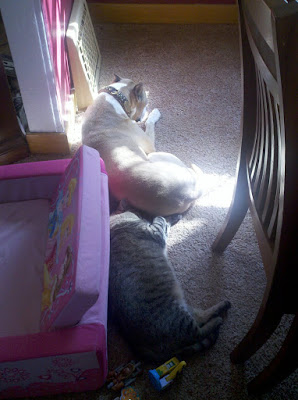
 “Tripp just lied down under the table and snoozed,” James says.