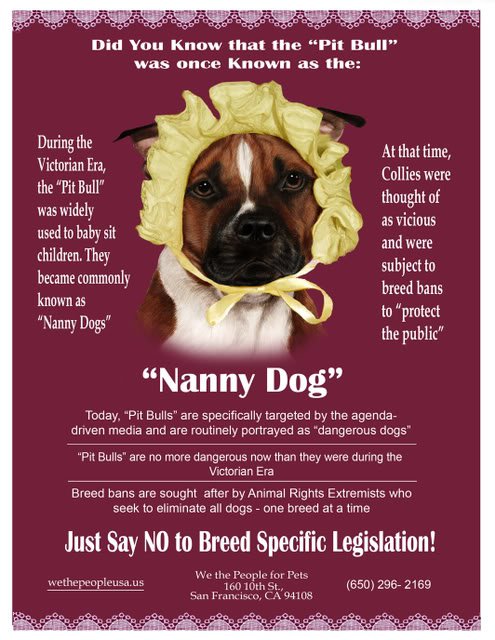
"A breed of satin and steel. Pit bulls are a mixture of softness and strength, an uncanny canine combination of fun, foolishness, and serious business, all wrapped up in love."

-D. Caroline Coile


Monday, December 13, 2010

Pit Bull Laws Have Teeth, Need Braces

Helen Keller owned one, as did presidents Theodore Roosevelt and Woodrow Wilson.

Sergeant Stubby died as a hero serving in France in World War I, and the lovable Tige was Buster Brown's best friend.

Even Petey, which ran the streets in the 1930s with the kids in Our Gang comedies, was a pit bull.

Whether real or fictional, the American pit bull was not always considered a pariah, demonized in news reports until communities worldwide legislated against it, and in some cases, banned it to reduce vicious attacks.

Dog advocates often refer to breed bans as knee-jerk reactions by politicians to highly publicized attacks, said Ledy Van Kavage, lead attorney for Best Friends Animal Society and co-author of a chapter on dangerous-dog ordinances in the American Bar Association book, Dangerous Dog Laws, published in 2009.

"I call them panic policymaking at its worst," Van Kavage, of Illinois, said of breed-specific laws. "In reality, any dog bites. We want good, safe legislation with the focus on reckless owners and generic, dangerous-dog laws."

Last week, the Dearborn, Mich., City Council turned down legislation to include breed-specific language (commonly referred to as BSL) in its vicious-dog law, in part because of a presentation by Van Kavage.

In Akron, the owners of certain dogs that are believed to be pit bulls, described as any American pit bull terrier, Staffordshire bull terrier, American Staffordshire terrier or any mixed breed of any of those dogs, and canary dogs, are subject to additional security requirements.

Few serious attacks

A study the American Veterinary Medical Association recently released estimates that about 72 million dogs live in the United States, with 37 percent of all households, or 43 million homes, owning at least one.

While dog bites seem to be rather common based on a national survey of about 10,000 people, the study indicates dog bite-related fatalities appear to be rare, at about three fatal bites per 10 million dogs.

A person would stand a better chance of dying from a lightning strike, the report shows.

The study, published in the October edition of the Journal of the American Veterinary Medical Association, was written by Gary Patronek, Margaret Slater and Amy Marder. The conclusion is that breed-specific legislation does nothing to prevent dog bites.

Using data from the Centers for Disease Control and Prevention, the state of Colorado and smaller jurisdictions, Patronek and his colleagues estimate that a community would have to ban more than 100,000 dogs of a targeted breed to prevent a single serious dog bite.

"Enthusiasm for BSL persists despite the lack of empirical evidence that legislation of this type reduces the risk of injury from dog bites or reduces associated costs to communities or insurers," the report indicates.

Breed-specific legislation is appealing to lawmakers for three reasons, according to the report: misperception of risk; misinformation and stereotyping; and erroneous beliefs about its effectiveness.

Sensationalized publicity about certain breeds being particularly aggressive, as well as popular beliefs about some breeds' physical and behavioral characteristics contribute to the erroneous belief that certain breeds have a propensity to bite people, the report states.

Saved from death row

Such misconceptions might have played a role in the fate of a bulldog Akron police impounded during a drug raid a few years ago. The owner of the dog, a suspected drug dealer, ordered the animal to attack officers.

Akron police face this situation all too often, said Lt. Rick Edwards, public information officer for the department.

Officers must assess the situation in each case, he said. If a dog charges an officer, it might have to be put down.

"Each situation is different. They have to look at the aggressiveness of the dog," Edwards said.

In this case, the officers felt the excited dog was vicious and ordered it impounded at Summit County Animal Control, where it was held for several months awaiting disposition of the case. Eventually, Municipal Judge Annalisa Williams issued an order to euthanize the dog because it was used in a crime, said Craig Stanley, director of administrative services for the county.

During the months the dog lived at the pound, caretakers began to realize it was no more than 7 or 8 months old when it had arrived. And although it fit Akron's physical description of a vicious dog, it was obvious the animal was deaf and could not have responded to the suspect's order to attack, Stanley said.

"I would play with him every time I went in. I could stand right next to him and shout his name and he didn't respond," Stanley said.

"When the [euthanization] order came out, a lot of the employees were sad about it."

He visited Judge Williams and explained the situation. She agreed to a plan to take the dog off death row. Pound workers moved it to a shelter outside the county, where it could be placed for adoption.

The chain of events illustrates the problems many animals face if they are the property of reckless owners, Stanley said.

Animal control is a law-enforcement agency charged with protecting the citizens of Summit County from vicious animals in a humane way.

Rescue groups, by contrast, have accepted the task of protecting animals from irresponsible owners, bad breeders and puppy mills, as well as dogs at the mercy of unscrupulous people.

Mistaken identity

Pawsibilities, the Humane Society of Greater Akron, is by law required to rescue and provide care for neglected and abused animals in Summit County.

Four years ago, as many as 80 percent of the dogs living at the Humane Society were considered pit bulls. Today, less than half that percentage call the Twinsburg shelter home.

"The Humane Society is one of the few shelters in the state of Ohio that takes them in and adopts them out," board member Carianne Burnley said.

Kristen Brannigan, director of behavior and adoption testing at the shelter, attributes the successful placements to programs designed to educate the public about "bully breeds." Also, DNA testing is made available — at a potential owner's expense — to determine whether any breeds singled out by law are in the dog's genetic makeup. The $85 tests have helped increase adoptions of long-term residents, she said.

"If the DNA test comes back with no 'bully' breed, the adoption rates skyrocket from 30 to 80 percent," Brannigan said.

At the Humane Society's National Pit Bull Awareness Day program in October, more than 250 visitors were challenged to "pick the pit bull" on a chart with photos representing 24 breeds. The photos were pulled from reputable, pure-bred breeders' Web sites, Brannigan said

"Not one [visitor] was able to pick out the American pit bull on the first try," Brannigan said.

The legal hassle of owning a dog that arbitrarily has been labeled a pit bull because of its appearance is one of the biggest problems the agency faces in placing animals.

Ohio is the only state that singles out "pit bulls" in its legislation as vicious dogs.

Brannigan said every dog at the Humane Society undergoes temperament testing before it may be adopted. Also, anyone who shows an interest in adopting a "pit-bull type" dog is advised of the law in his or her community and given leads on insurance companies willing to provide the $100,000 in liability coverage necessary to comply with Ohio law.

DNA testing in many cases is proving that although a dog's characteristics might indicate a certain breed, the animal's parentage is not reliably assessed by its appearance.

A study published this year in the Journal of Applied Animal Welfare Science indicates that many mixed-breed dogs do not resemble the predominant breeds identified by a DNA analysis. The study, conducted by Victoria Voith, Elizabeth Ingram, Katherine Mitsouras and Kristopher Irizarry, shows there is little correlation between the probable breed composition assigned to a dog and the identification of breeds by DNA analysis.

In other words, it is unwise to judge mixed-breed dog by appearance.

"Justification of current public and private policies pertaining to breed-specific regulations should be reviewed," the study concluded.

Overcoming their past

Best Friends Animal Society Sanctuary, a 33,000-acre animal rescue and rehabilitation center based in southern Utah, recently kicked off a national initiative called Saving America's Dog, to restore the pit bull's image and to challenge breed discrimination laws across the country.

In April 2007, in a highly publicized case, 51 pit bulls were seized from a dog-fighting operation at Bad Newz Kennels, owned by NFL quarterback Michael Vick in Smithfield, Va. Vick was ordered to pay nearly $1 million to rehabilitate the animals.

Animal advocates Bill and Kim Jones of Bath Township, who became involved with Best Friends when they helped the agency rescue animals after Hurricane Katrina, were called on to help rehabilitate 22 of the most challenged dogs taken to the sanctuary. They spoke Wednesday at the Fairlawn branch of the Akron-Summit County Public Library.

The Joneses arrived at Best Friends the same day as the Vick dogs. They found the animals so traumatized, they cowered in corners when humans entered their pens and refused to cross thresholds because "it meant something bad was going to happen to them," Kim Jones said.

Today, with some mishaps along the way, the majority of the Vick dogs are doing well. Three are certified therapy dogs and many have found new, adoptive homes after their painful start in life, Bill Jones said.

Because of the experience, the couple, along with Best Friends, have become breed advocates urging the removal of breed-specific language in favor of more effective laws to protect people from vicious dogs. Best Friends will be bringing that message to Ohio next year, Bill Jones said.

"Best Friends has targeted Ohio to get the [breed-specific] law rescinded," Jones said.

Readers can take a "pick the pit" challenge at http://www.pitbullsontheweb.com/petbull/findpit.html

By Kathy Antoniotti
http://pets.ohio.com/2010/12/pit-bull-laws-have-teeth-need-braces/

Wednesday, December 8, 2010

Pit Bull Halts Flow of Tears With Toys and Tenacity

When Susan Dyer Reynolds hired a professional trainer for her newly adopted pit bull, Jasmine Blue, the trainer started his assessment by putting a treat on the floor and saying, "Off." Of course, Jazzy went straight for the treat and promptly got squirted with a water bottle. Again, he put a treat on the floor. This time Jazzy looked at it longingly, but didn't move. When the trainer said, "It's OK," only then did Jazzy timidly approach the treat. "She's going to be easy," the trainer told Reynolds. "She's smart and incredibly sensitive."

After the trainer left, I went downstairs to check on my dad, who was watching a baseball game. Jazzy climbed into bed with him and tried to sneak in another bath of kisses. My dad laughed, and she wagged her big pit bull butt. "I love my granddog," he said. "I know," I smiled, "and she loves you, too."

One week later, my 76-year-old father passed away quietly in his sleep.

The day that followed was a whirlwind of friends taking turns making sure I was never alone. When my dad's longtime girlfriend, Kickie, arrived, she fell into my arms, a pile of grief and tears. Later that evening, we sat on the sofa, talking a bit, but mostly just sitting in stunned silence. Then Kickie perked up.

"Where's Jazzy?" she asked. Normally Jazz was there - usually on the sofa between my dad and Kickie, while I was relegated to the dog bed because there wasn't enough room on the sofa for me.

Kickie headed downstairs to check on her. When she returned, she was clutching my dad's favorite hat. "Jazzy was lying on your Dad's side of the bed," she said, tears streaming down her face. "She got up and went into his closet, sniffed his shoes, his slippers and his hat, then got back up on his side of the bed again. It's like she knows he's gone."

A week later, I drove Kickie to her home in San Jose. When I returned, it was the first time I had been alone, and that's when it finally hit me. I curled up on my bed and was sobbing when I felt something push at my back. I turned around to see Jazzy above me holding her pink stuffed bunny. Her ears were back and her butt was wagging tentatively. I rolled over and continued crying.

Again, I felt something nudge my back. This time she had her orange octopus. "Go away, Jazzy," I said. But she didn't listen. Now she had her Girducken, a stuffed duck with giraffe spots. When I sat up, I discovered she had taken every toy out of her toy box, as if she were determined to find the right toy, the one that would make me stop crying, the one that would make it better.

I wrapped my arms around Jazzy's neck and wept into her fur. She rubbed her cheek against mine, she pawed at my arm and she tried to put the Girducken in my mouth. When I started laughing, she dropped it on the bed and tried to give me a lick. Some people like it, some people don't; I'm one of those people who doesn't mind. Not when it comes from an incredibly sensitive dog.

This story first appeared in "Jasmine Blue's Tails of the Dog Park," published monthly in Northside San Francisco magazine ( http://www.northsidesf.com/). Reynolds is working on a book based on the column.

By: Eileen Mitchell
http://www.sfgate.com/columns/pettales/

Sunday, December 5, 2010

Video du Jour

Hector The Pit Bull’s Never Ending Quest For The Perfect Bed


http://www.thedogfiles.com/2010/12/01/hector-the-pit-bulls-never-ending-quest-for-the-perfect-bed-video/

Pit Bull Thwarts Home Invasion Attempt

When the Boltz family adopted the deaf Pit Bull, they knew that she would provide them with wonderful companionship. What they didn't know was that the newly adopted dog would save their house, perhaps even their lives.

Just weeks after adopting the deaf dog, someone attempted to break into the family's home in the middle of the night. They first attempted to access the home through a cellar door, breaking a chain. They eventually smashed a window and kicked in a door.

A brazen, bold attack on an innocent, sleeping family. But there was a surprise in store for these would-be robbers. Inside of the home, they were met by a 165 lb Great Dane, and the family's newly adopted deaf Pit Bull, Dolly.

The family heard the commotion and they were able to call their senior Great Dane back, but the deaf Pit Bull, unable to hear the frantic calls, chased the crooks away into the darkness.

The family was frantic - their newly adopted dog was lost. The next day, they contacted the local humane society and animal shelter. After 48 hrs., they attempted to file a report for the missing dog, but the police did not want to help.

They tried to contact the local media, to share her heroic tale, as well as to get assistance in locating the lost dog. They were told by the media outlets that they could not run a story like that because of the stigma surrounding Pit Bulls.

Rescue Ink learned of the lost hero dog and they assisted the distraught family in their desperate search. Thankfully, after several days of searching and multiple postings of "lost dog" flyers being put up, Dolly was found.

It turns out that a neighbor had found the lost dog. She had taken her in after seeing her running loose. The neighbor was frightened for the dog's safety - apparently she had overheard some boys talking about capturing Dolly and using her for fighting.

When the neighbor saw the lost dog flyers, she called the owners and a happy reunion followed.

Dolly is an amazing dog. She courageously protected her family, even though that family was new to her. After just weeks in her new home, she may have literally saved her family's life.

Who knows what the people were capable of? To smash windows and kick in the doors of a home that is occupied is a bold move - perhaps desperate. Thankfully for Dolly, the Boltz family will never have to know what those people had in mind that night.
As for that local media that would not share Dolly's heroic tale due to her breed? They didn't hesitate to run 2 stories in the following weeks about Pit bull attacks. It would seem that they pick and choose what information they want the residents of the area to hear.

By: Penny Eims

http://www.examiner.com/dogs-in-national/dog-scares-off-burglar-a-surprising-hero?sms_ss=facebook&at_xt=4cdd8309a3014409%2C0

Thursday, December 2, 2010

Blind Kids Get A Helping Paws From Pit Bulls

Pit Bulls, a breed often associated with the stereotype of uncontrollable aggression, are proving just how loving, protective and helpful they can be to those in need!!!


Visit msnbc.com for breaking news

Sunday, November 28, 2010

Peanut-Detecting Dog Sniffs Out Danger, Helps Boy Fight Peanut Allergy

Grey Sheer, who's allergic to peanuts, snuggles up to Layla, the family’s pit bull mix that's been trained to detect their scent.

As a service dog in training, Layla searches her family's grocery bags, kitchen cabinets, backpacks, stairwells, playgrounds, hotel rooms and other suspicious areas for the odor she was trained to detect: peanuts.

When the young pit bull/bulldog mix detects even the tiniest scent of a peanut, she lies down on her belly, stares at the culprit and points with her paw.

Her reward: a squeaky ball.

This subtle act of heroism is a lifesaver for her Manhattan owners and their 6-year-old son, Grey, whose severe allergic reactions to peanuts and shellfish have landed him in the hospital at least a dozen times.

The boy's food allergy first reared its head when, at age 2, Grey went into anaphylactic shock after eating a peanut butter cracker that had rolled under the couch.

"We're constantly afraid that he's going to die," said his mom, Catherine Sheer, 28, who noted that Grey's allergy is so bad he can break out in hives just walking down the aisle at the Whole Foods market. "It's like living in a world where there's cyanide everywhere," she added.

Peanuts - or their scent - are all around us. Their residue, which can be in the form of butter, oil or dust, is found or left behind in schoolyards, libraries, movie theaters, on airplane seats and just about anywhere people go.

For that reason, many kids with peanut allergies are home-schooled and rarely have play dates.
"I was determined for him to have a normal life," said Sheer, who is dismayed that service dogs are not allowed in New York City's public schools.

Still, Grey attends public school in Chinatown - unlike his preschool, it is not peanut-free - where he is shadowed by a paraprofessional who makes sure the boy steers clear of any nuts. Grey's family and the school nurse are armed with epinephrine and Benadryl to treat allergic reactions.

Meanwhile, Layla, a rescued pooch, was never meant to be a peanut-detector dog. Grey and his mom were on their way home from school one day when they spotted the 4-month-old puppy playing in the window of the Animal Haven Shelter in SoHo. Layla had been flown in from an overrun Missouri shelter by Paws and Pilots as part of a big rescue effort.

It was love at first sight for Sheer when Layla licked her hand and then rolled over and went to sleep.

"She's gentle and calm and the best dog in the universe," Sheer said of the mixed breed with a bad reputation, who, despite urban myth, is even tender with her year-old baby, Scarlett.

The idea to train Layla as a scent detection dog occurred to Sheer in August during a month-long family trip to San Diego, but she was told that scent dogs are generally shepherds, poodles and golden and Labrador retrievers.

When the family took a day trip to Legoland, however, Layla stayed at the Snug Pet Resort, where trainer Mike Stone saw great promise in the loyal mutt as a "peanut dog" and agreed to try training her, Sheer said.

After spending two months out West with Stone, Layla recently returned to Manhattan, where, despite her young age and breed, she continues to show great promise as a lifesaver for Grey.

While pit bulls aren't generally used as scent dogs, Sheer believes their great desire to please their owners make them worthy of the job.

http://pitbullpositive.ning.com/forum/topics/peanutdetecting-mutt-layla?xg_source=facebookshare

">

http://www.nbcsandiego.com/news/health/Rescued-Pit-bull-Sniffs-Out-Danger--113139989.html?__source=Facebook

Tuesday, November 23, 2010

The Oddest Couple in the World

A male Chihuahua's tenacity in guarding his beloved pit bull girlfriend helped save their lives. Now, the couple is inseparable.

Sometimes even an abandoned, injured dog with a bad rap ends up doing great things. And so it was with a female pit bull, being guarded by her beloved boyfriend, a Chihuahua.

What the Pennsylvania dog warden did not realize when he rescued the pair on Labor Day, was just what a sweet story these two dogs had to tell.

Once the pit bull got into a crate on the warden's truck, the Chihuahua would not follow. Instead, he put himself between the two, barking and growling at the warden.

"So I sat on the ground ... all the time having a conversation with a Chihuahua that was guarding a Pit Bull!," the warden writes in a story about this odd couple.

"Eventually he let me get close enough so we could have a face to face & heart to heart discussion. I told him that his intentions were very noble and would not go unrewarded for the both of them."

The warden would not follow his usual routine when finding a pit bull — to take the dog to a facility that could euthanize her within 48 hours. "Due to this little guy's tenacity and I do believe true affection for his Pit Bull lady," the warden writes, "I was not going to let that happen." Cute couples, it turns out, melt hearts.

The warden found them safe haven at the no-kill Washington Area Humane Society. He asked the staff, could they please find room in their already overflowing no-kill shelter for just two more dogs?

"We truly didn't have room but we could not let them go," says Alice Wancowicz, assistant manager of the shelter in Eighty Four, PA. "They stayed in the bathroom for two days until we could get a run open."

And so, the staff embraced the pair, naming them Bonnie and Clyde. "We were trying to think of a good duo kind of name," says Wancowicz. "They're kind of like rebels but they're not, they stick together."

Now, it is Bonnie who protects little Clyde. "They are just adorable together," Wancowicz says. "Bonnie just lays there and Clyde jumps all over her. They are totally inseparable." The couple goes on walks together, eat together, sleep together, with Clyde snoozing on top of Bonnie or cuddled within her front arms.

"When Bonnie got spayed, Clyde was beside himself," Wancowicz says. "He wouldn't settle down, was crying, on your lap, off your lap, you could tell he wasn't himself."

So it comes as a surprise that they have not been adopted. "They would fit in anywhere," says Wancowicz. "They don't have issues with adults or kids."

The dog warden writes that we need to change our opinions of pit bulls: "You may find a loving, loyal and dedicated companion to fight for like our Chihuahua friend did. Perhaps this story will give you a second chance to revisit your thoughts and opinions concerning Pit Bulls. They deserve the opportunity to overcome a stereotype that can most certainly lead them to death."

We know that Tonic readers like to take action. If you want to help out Bonnie and Clyde, click here (http://www.washingtonpashelter.org/) to visit the Humane Society's website. Or, you can call them at 724-222-PETS (7387)

By Diane Herbst
Photos courtesy Washington Area Humane Society.
http://www.tonic.com/article/the-oddest-couple-in-the-world/

Friday, November 19, 2010

Saving Audie: A Pit Bull Puppy Gets a Second Chance

When Michael Vick's dog fighting ring was discovered, more than forty dogs were rescued. But their struggle was far from over. Most animal advocates believed the former fighting dogs were too damaged to save, but Audie and his kennel mates would prove them wrong when public outcry and the publicity surrounding Michael Vick's punishment won them a chance at a happy life. Teaming up once again with William Muñoz, photo-essay veteran Dorothy Hinshaw Patent gives an emotional account of one dog's heartwarming story, showing how Audie, who was only a puppy when he was rescued, was rehabilitated, adopted, and now enjoys the love he deserves.

Buy the book here.

Check out Audie's Facebook page.

Wednesday, November 17, 2010

Dog Owner Can't Forgive Michael Vick


An appropriate article to read after Michael Vick's blowout game last night. (Not to mention Desean Jackson's comments)
Mel, a black pit bull, cowers to the corner while another dog, Pumpkin, shields him. Mel was one of the 47 pit bulls in Michael Vick's interstate dogfighting ring. (Richard Hunter / November 16, 2010)

While Michael Vick was screaming toward the sky, a black pit bull named Mel was standing quietly by a door.

On this night, like many other nights, Mel was waiting for his owners to take him outside, but he couldn't alert them with a bark. He doesn't bark. He won't bark. The bark has been beaten out of him.

While Michael Vick was running for glory, Mel was cowering toward a wall.

Every time the 4-year-old dog meets a stranger, he goes into convulsions. He staggers back into a wall for protection. He lowers his face and tries to hide. New faces are not new friends, but old terrors.

While Michael Vick was officially outracing his past Monday night, one of the dogs he abused cannot.

"Some people wonder, are we ever going to let Michael Vick get beyond all this?" said Richard Hunter, who owns Mel. "I tell them, let's let Mel decide that. When he stops shaking, maybe then we can talk."

I know, I know, this is a cheap and easy column, right? One day after the Philadelphia Eagles' quarterback officially becomes an American hero again, just call the owner of one of the dogs who endured Vick's unspeakable abuse and let the shaming begin.

Compare Vick's 413 total yards, four touchdown passes and two rushing touchdowns against the Washington Redskins to the 47 pit bulls who were seized from Bad Newz Kennels, his interstate dogfighting ring. Contrast one of the best three hours by a quarterback ever to the 21 months he spent in prison.

Cheap and easy, right? Not so fast. Vick's success is raising one of the most potentially costly and difficult perceptual questions in the history of American sports.

If he continues playing this well, he could end up as the league's most valuable player. In six games, he has thrown for 11 touchdowns, run for four more touchdowns, committed zero turnovers and produced nearly 300 total yards per game. Heck, at this rate, with his Eagles inspired by his touch, he could even win a Super Bowl, one of the greatest achievements by an American sportsman.

And yet a large percentage of the population will still think Michael Vick is a sociopath. Many people will never get over Vick's own admissions of unthinkable cruelty to his pit bulls — the strangling, the drowning, the electrocutions, the removal of all the teeth of female dogs who would fight back during mating.

Some believe that because Vick served his time in prison, he should be beyond reproach for his former actions. Many others believe that cruelty to animals isn't something somebody does, it's something somebody is.

Essentially, an ex-convict is dominating America's most popular sport while victims of his previous crime continue to live with the brutality of that crime, and has that ever happened before?

Do you cheer the player and boo the man? Can you cheer the comeback while loathing the actions that necessitated the comeback? And how can you do any of this while not knowing if Vick has truly discovered morality or simply rediscovered the pocket?

If you are Richard Hunter, you just don't watch football.

"When you look at Mel," said Hunter, a radio personality from Dallas, "you just don't think about how Michael Vick is a great football player."

A couple of years ago, Hunter and his wife Sunny were watching a documentary on Best Friends Animal Society, the Utah sanctuary where the court sent 22 of Vick's 44 seized dogs. It was after 1 a.m. when the show featured a Vick victim that had been so badly abused, it refused to move, behaving as if paralyzed.

"My wife said, 'Get out of bed, get on the computer and e-mail those people, I want one of those dogs,' " Hunter recalled.

Nearly 18 months later, they became one of six people to adopt one of the dogs. The process included a home visit by caseworkers, an extended visit to the southwest Utah sanctuary, home monitoring by a dog trainer and a six-month probation period.

"These dogs were scarred in many ways both emotional and physical," said John Polis, Best Friends spokesman. "It was something we had never really seen before."

Hunter and his wife quickly saw Mel's scars. The dog wouldn't bark, wouldn't show affection, and would spend nearly an hour shaking with each new person who tried to touch him.

It turns out that Mel had been a bait dog, thrown into the ring as a sort of sparring partner for the tougher dogs, sometimes even muzzled so he wouldn't fight back, beaten daily to sap his will. Mel was under constant attack, and couldn't fight back, and the deep cuts were visible on more than just his fur.

"You could see that Michael Vick went to a lot of trouble to make Mel this way," Hunter said. "When people pet him, I tell them, pet him from under his chin, not over his head. He lives in fear of someone putting their hand over his head."

On Monday night, no, Mel was not hanging out by the televised football game. He was hanging on his owner's bed as they watched something on HBO.

"How can you support football when you know one of their stars did this to a dog?" Hunter said. "If more people saw Mel at the same time as they saw Michael Vick, he wouldn't be so lauded."

Meanwhile, in Philadelphia, the lessons learned from Vick's crimes were on display in a postgame quote from Eagles star receiver DeSean Jackson.

"We were like pit bulls ready to get out of the cage," he told reporters.

Cheap and easy, huh?

By Bill Plaschke

http://www.latimes.com/sports/la-sp-plaschke-20101117,0,5163298.column?page=1

Thursday, November 11, 2010

In Honor of Veterans Day

Here's an incredible story about the value dogs have in the lives of veterans suffering from PTSD. Starring a pit bull named Cheyenne.


When You Think of Liberty Think of Me

 When you honor the red, white, and blue
When you celebrate our nation's liberty
Think of the one who's been beside you
in spirit, in heart, in body...
No being could be as loyal as me, for I am
your best friend, your partner... your family

When our nation was young
I was the runner, carrying messages
in a war that would leave us undone
where brother fought beside brother.

And, alone in the face of terror
I moved through enemy lines,
as families fought one another,
my mission foremost in my mind.

I was the one waiting for you even though
I sensed you would not be coming home
I languished on our wooden porch
growing thinner, until the war was over
and my days on earth were done.

I was in the trenches, fields, and meadows
accompanying you into foreign lands.
With you in the jungles and swamps
and at your heels on hot, dusty roads
or on blistering, desert sands.

I have been first in the line of fire
first to enter a field laden with mines
putting myself in your stead.
I went unflinching, leading,
to wherever, doing whatever you said.

With you I've jumped from the belly of a plane
dropping into places neither of us had ever seen.
All for the greater glory and good. All for humanity.

When a bullet took your life I laid by your side
my chin on your chest--despair in my eyes.
Content to have remained with you,
until a man in our unit lifted me up,
carrying me back to the war... as he cried.

When we had parted, when you'd gone home
and when on foreign soil I was left all alone
through no fault of your own I was forsaken.

The government advised you that your friend
and helper; the soldier who'd been by your side,
would not be accompanying you home...
To our home, our country, I could not be taken.

And so it was that we were abandoned
after you tearfully told us we could not follow
the men with whom we had served.

Confusion set in as we watched you depart;
being left behind, we had not deserved.
You left us dispirited, empty, and hollow
for we had given to you all of our all.
Like ghosts were we, missing our souls,
for you had taken with you... our hearts.

I have been injured for you.
And I have died for you.
In your absence I have wasted away
from the loss of you.

I'm the scruffy, thin dog sitting quietly
next to the veteran in his wheelchair.
On the hill, the band plays a song
and the man softly cries, while
fireworks light up the night's air.

Gently I place my paw on his knee
lay my muzzle on his withered leg.
He looks at the small flag he is clutching
then he turns his attention to me.

His eyes are filled with thoughts and tears
but his smile is as warm as the sun.
"Thank you for reminding me," says he,
"what's been sacrificed for the freedom we've won."

In the now, we cannot know
who will be needing who.
But what you may not know is
that when you'll be needing me
I'll be needing and looking for you.

We've been a team, you and me
through the many years
that have shaped this land,
and God has blessed us mightily.

So, every now and then, thank me--
with a look, kind words, and the
touch of a gentle hand...

When you think of liberty
and count the reasons you are free...
Don't forget to think of me!

Copyright © 2004 by Kathy Pippig Harris


Read an article here about Sgt. Stubby, America's first canine war hero.

Read the story about a veteran who was prescribed a pit bull after serving in Iraq. Denver, Colorado said that the service dog violated the city's ban on pit bulls.

Wednesday, November 3, 2010

Pit Bulls' Visits Heal Patients, Reputation

 
Joyce Baldwin, Plainfield Nursing and Rehabilitation Center resident, loves visits from Murphy, a 4-month-old pit bull. Murphy's owner believes pit bulls make good therapy dogs. / Matt Kryger / The Star

Pit bulls have long been known for their vicious behavior and little else.

Whether it is fighting other dogs to the death or attacking people, pit bulls have developed a bad reputation that has been hard to shake.

A Mooresville woman, though, is making an attempt to tear down that stereotype one nursing home at a time.

For the past six months, Kim Lane has visited nursing facilities in Anderson, Martinsville, Mooresville and Plainfield with her "two boys" -- Milo, a 3-year-old pit bull, and more recently Murphy, a 4-month-old pit bull -- to provide therapy for staff and residents.

"I promised Milo when he was a puppy that we would change people's minds," she said. "It was hard at first because as soon as some places heard the word pit bull, they said, 'no.' I even gave up at one point. But six months ago, I decided I would try even harder, because I felt Milo's talents were just wasting away."

Milo already has a Canine Good Citizen certificate and is being trained to be certified as a therapy dog and to serve in hospices.

Lane said what makes pit bulls such good therapy dogs is the same trait that some owners take advantage of when they are training them to fight and be mean.

"Pit bulls will do anything to please their owner, even if it means fighting to their death," Lane said. "But if you channel that desire to do good things they were meant to do, they have the perfect disposition for it. My dogs have been treated and handled with nothing but love, so Milo, in particular, is just one big mush ball."

The people who get weekly visits from Milo and Murphy couldn't agree more. Many say it is the highlight of their week.

Joyce Baldwin, a resident at Plainfield Nursing and Rehabilitation, can't wait to have the dogs climb up on her bed with her.

Baldwin said she lost her dogs just prior to moving to the facility. So Lane's dogs have helped her cope with the depression many nursing-home residents endure.

"Aren't these dogs the sweetest things?" Baldwin said. "They have brought me so much joy and always cheer me up. What you hear about pit bulls isn't true. They are good dogs. I don't know how anybody could not like these two."

Chris Ray, administrator at the Plainfield facility, said he believes in pet therapy and often uses dogs, birds and even fish to help cheer up and relax residents there. So he was delighted and had no hesitation about having pit bulls come into the facility as therapy dogs.

"You always think about the concerns when you hear pit bull, but once you meet them, that all goes away," he said. "You can just see the change in the residents' faces when the dogs come around."

Lane said she believes both dogs can sense when someone needs extra love and attention.

They can even do a few tricks to entertain residents, and Lane also allows residents to feed them low-fat treats.

"As long as we can change at least one person's mind about pit bulls and make someone happy every visit, I consider it a good, productive day, and hopefully, it starts a domino effect that changes people's perceptions," she said.


By: Josh Duke

http://www.indystar.com/apps/pbcs.dll/article?AID=201010140337

Monday, November 1, 2010

Pit Bull Resources

Here is a list of pit bull resource websites compiled by
The American Dog Magazine:

All or Nothing Pit Bull Rescue  
http://www.atlantapitbullrescue.com/

Animal Farm Foundation  
http://www.animalfarmfoundation.org/

Bad Rap
http://www.badrap.org/

Bama Bully Rescue 
http://www.bamabully.org/

Bless the Bullys   
http://www.blessthebullys.com/

Bull 911 
http://www.bull911.com/

Casa Del Toro Bully Breed   
http://www.casadeltoro.org/

Chicagoland Bully Breed Rescue   
http://www.chicagolandbullybreedrescue.org/

Dead Dog Walking Pit Bull Rescue   
http://www.deaddogwalkingpitbullrescue.org/

Defending Dog  
http://www.defendingdog.com/

Denver Kills Dogs   
http://www.denverkillsdogs.com/

For Pits Sake   
http://www.forpitssake.org/

Hug A Bull   
http://www.hugabull.com/

Indy Pit Crew   
http://www.indypitcrew.org/

Karma Rescue   
http://www.karmarescue.org/

Love A Bull Rescue   
http://www.loveabullrescue.com/

Mid-America Bully Breed Rescue    
http://www.kspitbullrescue.com/

Mike's Dog House   
http://www.mikesdoghouse.org/

Missouri Pit Bull Rescue   
http://www.mprgroup.net/

Natl Canine Research Council   
http://www.nationalcanineresearchcouncil.com/

Our Pack   
http://www.ourpack.org/

Out Of The Pits   
http://www.outofthepits.org/

Pawsitively Pit Bull   
http://www.pawsitivelypitbull.org/

Pit Bull Rescue Central   
http://www.pbrc.net/

Pit Bull Lovers   
http://www.pitbulllovers.com/

Pit Bull Rescue San Diego   
http://www.pitbullrescuesandiego.com/

Pittie Love Rescue   
http://www.pittieloverescue.com/

Recycle-A-Bull Rescue   
http://www.workingpitbull.com/

Roverlution   
http://www.roverlution.org/

Save A Bull Rescue   
http://www.saveabull.com/

Save The Pit Bulls   
http://www.savethepitbulls.8m.com/

Stop BSL  
http://www.stopbsl.com/

Understand A Bull  
http://www.understand-a-bull.com/

Villalobos Rescue Center  
 http://www.vrcpitbull.com/

Wiggle Butts Bully Rescue  
 http://www.wigglebuttsbullyrescue.org/


www.theamericandogmag.com/departments/resources-save-the-pits

Friday, October 29, 2010

Three Things You Can Do To Make Your Community Pit Bull Friendly

This past Saturday was National Pit Bull Awareness Day so I hope everyone was thinking pits as they went about their daily rounds. They certainly were aware of Pit Bulls in the Bronx (yeah, I know it’s Bronx, N.Y., not the Bronx, but that’s where we lived when I was born and it’s always been da Bronx to me). To help plant a flag for this annual commemoration, Best Friends sponsored Pet Bull Palooza at Crotona Park in the Bronx in collaboration with ASPCA and The Mayor’s Alliance for New York City Animals. The ASPCA rolled in two of their mobile spay / neuter vans (which were booked out by 8am) and scheduled a few dozen more follow up appointments with local’s eager to customize their pit bulls. In addition to free spay / neuter services, PBP offered:

•Free vaccinations and microchip
•Free ear cleaning and nail trimming
•Free leashes and collars for first 300 dogs
•Free toys and treats for first 300 dogs
•Free dog food

Everything went! What a great day. These kind of events make the point against mandatory spay / neuter laws…no law required…if you provide low cost or free s/n services, they will come. But I digress.

Why all the attention on pit bulls? Well, for a variety of reasons, they are the most killed breed/type of dog in America’s shelters. If we want to get to No More Homeless Pets, pits are an essential piece of the puzzle.

Pit Bulls rock! They are remarkable, eager to please, animals with mad athletic skills and an abundance of personality. Of course you can make them fight, you make them do just about anything…including make coffee, but what they’re best at is being ridiculous… big grins, a motor driven tail and goofy poses and expressions.

Best Friends is committed to restoring the reputation of pit bull type dogs and has some exciting programs in the works featuring very effective tools and resources to help keep your community pit bull friendly.

At the No More Homeless Pets Conference 10 days ago, we were delighted to announce a partnership with Petsmart Charities called the “Shelter Partners for Pit Bulls Project”. Basically it’s a pilot project based on a very successful partnership between Best Friends and Salt Lake County Animal Services. It’s had a demonstrable impact on increasing the number of pit type dogs adopted and consequently reducing the number of such dogs surrendered and killed at Salt Lake County Animal Services.
Petsmart kicked in $240,000 to get the program started in 5 target communities that Best Friends will partner with: Rancho Cucamonga, California, Baltimore, Maryland, Washington, D.C., Carlsbad, California and Tampa, Florida.

All great stuff you say, but what can I do in my city to make it Pit Bull friendly?

Here are three things you can do to keep your community Pit Bull friendly:

1. Be Proactive
Does your community have a comprehensive dangerous dog ordinance? If not, don’t wait, take steps to get a good one passed. It will be a bulwark against regressive and reactive breed bans or other breed discriminatory regulations. A good dangerous dog ordinance targets the deed, not the breed. It focuses on irresponsible owners of whatever breed of dog who encourage aggressive behavior, take pleasure in having the “baddest dog” in the neighborhood, blow off neighbors concerns and turn their dogs into extensions of their own anti-social selves with the result being that when, not if, someone gets bitten, the dog and probably the breed get blamed. Best Friends has model dangerous dog ordinance language available and our team will be happy to help shepherd you through the process of working with local officials to get good laws in place before bad laws are dreamed up by grandstanding and / or uninformed politicians. Click here for model ordinances, resources and more.

2. Use The Best Friends Breed Discriminatory Fiscal Impact Calculator

If your community is plagued by a grandstanding pol or has a well meaning but uninformed neighborhood activist or for some other reason is considering a breed ban or some other form of breed discriminatory legislation, the best strategy to move the conversation from fear mongering hysteria to a rational discussion of what’s best for the community, use THE CALCULATOR! The Best Friends BDL Fiscal Impact Calculator will tell you how much it will cost the taxpayer to enforce, defend and implement a breed ban. When dollars come into the conversation, everything slows down and the reality of a breed ban can be considered in a different light. Does your community really want to introduce a police state with door-to-door searches that leaves kids crying on the doorstep as family pets…family members…are hauled off to be killed or does it really want to protect the community and promote responsible pet ownership through proactive enforcement of progressive dangerous dog laws.

3. Host A Pit Bull Palooza
Have some fun, fix some pits, create a community of pit bull advocates who love these dogs and are sending all the right messages.

Pits are great dogs and they need our help to get out of shelters, to stay out of shelters and to be recognized for the great dogs that they are. For help and resources for your community be sure to visit the Best Friends campaign site for Pit Bulls: Saving America’s Dog.

By Francis Battista
Article found here.

Wednesday, October 27, 2010

Pit Bull Owners Take a Stand for Their Dogs

We've all heard the stereotypes: only criminals own pit bulls, people only want these dogs to fight them, pit bull owners don't care about their dogs.

And we all know where these stereotypes lead: to pit bull-type dogs facing unfair restrictions and bans, innocent dogs not getting a fair shot at adoption, and thousands of animals killed by shelters just because they look a certain way.

The best way to break stereotypes is to shatter them with reality. Everyone who lives with a pit bull knows this; we've all converted friends and family who abandoned their media-generated fears once they spent a little time up close and personal with our dogs. Many of them went on to adopt their own pit bulls.

And that's why Pit Bull Rescue Central created the "I Own a Pit Bull" campaign. It's time for pit bull owners to stand proud and dispel all those myths about pit bulls and the people who share their lives with them.

When cities, like Denver, pass breed specific legislation, they think they're targeting the drug dealers and other criminals in their town; people too busy breaking the law to go to the polls. Because it's proven again and again that knee-jerk policies targeting dogs based on breed don't reduce dog bites or reach irresponsible pet owners.

City officials don't imagine that they're profiling the small business owners, doctors, nurses, veterinarians, artists, computer programmers, teachers, waitresses, neighborhood watch coordinators, community volunteers ... but that's who's impacted whenever laws are passed that judge a dog based on his appearance, and not his individual actions and the irresponsibility of his owner.

So, now through tomorrow, October 23, use your Facebook status to stand up for your dog and show that you're not a stereotype. The formula is easy, and PBRC gives a few handy examples: I own a pit bull and I vote Green Party; I own a pit bull and I am a cancer survivor; I own a pit bull and I need coffee to get going in the morning. PBRC also provides a template for "I Own a Pit Bull" business cards that you can hand out. If you don't have a pit bull, use your status to show that people who love pit bulls and support their owners come from all walks of life, too.

Why now? Saturday, October 23, is National Pit Bull Awareness Day. At events across the country, pit bull owners, rescuers and advocates will be setting the record straight, promoting responsible pit bull ownership and showing their communities how fantastic these dogs are. I encourage everyone to check out the events in your community, and do your part to start changing minds.

Breed profiling is nothing new. Bloodhounds, Dobermans, German shepherds, and Rottweilers have all that their day. But the prejudice against pit bulls is unprecedented. The constant, widespread access to media reports of "pit bull attacks" (regardless of whether the dog was actually a pit bull or whether there was actually an attack) has kept the fear alive, and every day, responsible pit bull owners face new threats of breed specific legislation.

The only way out of this cycle is education, not only about the misconceptions about these dogs and the failings of breed specific legislation, but also about who we are.


by Stephanie Feldstein

http://animals.change.org/blog/view/pit_bull_owners_take_a_stand_for_their_dogs#share_source=blog-top_fb

Saturday, October 23, 2010

National Pit Bull Awareness Day!

The National Pit Bull Awareness campaign is a nationwide effort to bring positive awareness and attention to the American Pit Bull Terrier and their responsible owners.

To anyone who shares their life with a "pit bull," the need for a national day of awareness for these misunderstood dogs is clear. Constant negative media attention and sensationalized hype that surrounds pit bulls has the breed in the spotlight for all the wrong reasons. The media and public have stereotyped and judged an entire group of dogs, as well as their owners, based on the actions of a few.

National Pit Bull Awareness Day was established as a day to educate and foster positive communications and experiences in the communities in which we and our dogs live. It is a day to focus on these incredible dogs and their devoted, responsible owners. A day to change perceptions and stereotypes.

The Pit Bull may be one of the most misunderstood animals in our country. For those of us who know this type of dog, we understand them to be incredible animals and great pets.
 
I cannot recall a single type of dog that has caused as much hype and hysteria as the Pit Bull. I say "type" because the Pit Bull is really not a breed but rather a moniker applied to several breeds with similar characteristics: American Staffordshire Terrier, Staffordshire Bull Terrier, American Bull Terrier and American Bulldog.

For responsible Pit Bull owners, we know these dogs to be loving, loyal, gentle companions that enrich our lives as much as we enrich theirs. We can relate to the "nanny dog" character, Petey (of Little Rascals fame), and see in our beloved pet the honor and courage of Sgt. Stubby, and of course the resilience and strength of heart of the now infamous Vick dogs. We are also constantly haunted by the threat of Breed Specific Legislation.

It is for this reason that responsible Pit Bull owners need to take the opportunity to join other responsible Pit Bull owners and organizations in supporting National Pit Bull Awareness Day.

On this day and every day it is imperative that we showcase our dog ambassadors at their best. Get involved with organizations that support education and programs to allow your "ambassadog" to interact with the public in positive ways.

Is your dog an AKC Canine Good Citizen? If not, make that your goal to gain CGC certification for the benefit of helping to minimize the negative public perception of your companion and to get some additional benefits from the AKC.

What do you know about Breed Specific Legislation? Educate yourself on the issues surrounding BSL, where BSL is enacted and how to get involved with fighting BSL in favor of more fair legislation that seeks to punish irresponsible dog owners rather than the dog.

And have a happy, safe National Pit Bull Awareness Day!

Article from:
http://www.chicagonow.com/blogs/dog-saving-network/2010/10/pit-bull-awareness-day.html
and
http://www.blessthebullys.com/national_pit_bull_awareness_day.html

What are YOU going to do to celebrate??
Find a pit bull event near you or volunteer at a local animal shelter!

Tuesday, October 19, 2010

York SPCA Program Aims To Keep Pit Bulls Out Of The Pits

Not enough people see pit bulls for what they are -- loyal, intelligent and high-energy companions that need training and love, according to Melissa Smith, executive director of the York County SPCA.

And the endless flow of pit bulls into the SPCA's Emigsville shelter is what happens when people own the dogs for the wrong reasons, she said.

"Some people see pit bulls as a status symbol," Smith said, or a money-making venture. "The dogs are purchased for breeding, which is the last thing we need, but unfortunately there's a market for this. And some people obviously want the dogs for fighting."

That's why the York County SPCA is launching a program to help York's inner-city youths train their pit bulls and SPCA volunteer Ed Temple of Mount Wolf walks Tanner, a male pit bull. The SPCA is holding a program on Saturday, Oct. 23, to help pit bull owners. (John A. Pavoncello Photo)learn to see them as companions, she said. The program is even open to city youths who don't own dogs, because the SPCA can provide shelter pit bulls for dog-less youths.

The program kicks off at 10 a.m. Saturday, Oct. 23, at Sovereign Bank Stadium, in conjunction with National Pit Bull Awareness Day. People are encouraged to take their pit bulls to the stadium, where they can receive free rabies shots and microchipping, and celebrate the pit bull breed, Smith said.

Plenty of freebies: The SPCA will also hand out free dog food to owners who need it, and people can sign up their dogs for free spaying or neutering as well as the new youth training program, she said. Pit Bull Awareness Day festivities will continue that day at the shelter from noon to 4 p.m.

The first youth-pit bull training class will be held Nov. 6 at the Princess Street Center, Smith said. The SPCA is targeting middle-school students for the program, she said, but won't exclude older kids.

"Pit bulls get a really bad rap and aren't treated the same way as other companion dogs are treated," she said. "We need to change public perception of these dogs."

Smith said she got the idea from the Humane Society of the United States' "Keep Your Pet Out of the Pit" program. "Pit" means dog-fighting pit.

"Our target group is youth, because if we can get to them early enough, we can get them to see pit bulls as companion animals, as they should be seen," she said.

Good for kids, too: Smith said the SPCA is inviting at-risk youths to join the program as well. In addition to training and socializing the dogs, the program could help bolster youths' self-esteem and sense of responsibility, she said.

The SPCA chose York City for the training because of the high concentration of pit bulls there and is partnering with the city's Recreation and Parks Bureau, which is providing usage of the Princess Street Center.

"We just think it's a wonderful program, to educate and change the views on pit bulls," bureau director Tom Landis said.

The training program will help youths teach their pit bulls basic obedience and good manners, Smith said, and eventually could be expanded to include other dog activities, such as agility training.

"The goal is really to build the bond between a young person and a dog, and to make young people see what great family dogs pit bulls can be with proper training and socialization."

The numbers: Currently, the shelter has 132 dogs, more than half of which are pit bulls, Smith said. She called that ratio normal.

Since January, the shelter has taken in 236 pit bulls, many of which came from York City, she said. The next most common breed seen at the shelter this year is the Labrador retriever, Smith said, with 80 dogs so far.

Many of the pit bulls that come to the shelter are very friendly, but some have been treated badly and not properly socialized or trained, Smith said.

High-energy dogs: "That's what we're trying to avoid," she said. "Pit bulls are very loyal, very intelligent. But having said that, a pit bull owner needs to understand their dog's tenacity and steer that trait in the right direction. They have a lot of energy and they want to please their owners."

That means plenty of exercise and direction, she said.

A pit bull's natural trait of being protective of its family has resulted in people exploiting the breed, she said.

"And that's very sad, because pit bulls will go to the ends of the earth for their owners," she said.

Author: Elizabeth Evans

Watch a video at the website:
http://www.yorkdispatch.com/ci_16347412

Wednesday, October 13, 2010

Pit Proud: The History Of The Pit Bull


I’ve been working on Pit Proud: The History Of The Pit Bull for well over a year. But I believe that every second that went into it was worth it, because I knew then and I know now that Pit Proud is the single, most important Dog Files Episode yet.

It’s the story of what I believe to be, the most maligned and abused animal on Planet Earth.

The Pit Bull.

A dog that the media has made out to be the “great white shark” of the land. A monster waiting to jump out of the shadows and attack your children.

But you know what I’ve found out over the course of researching, writing and crafting this episode?
Pit Bulls… are just dogs. No more, no less.
And like all dogs, they are individuals with individual personalities and temperaments. But because of their intense loyalty and strong form, the pit bull has been singled out amongst lesser men to abuse and kill for their small-minded, cruel entertainment.

You see, the pit bull problem isn’t the dogs, by any means.

The pit bull problem is people.

The people that want to fight them. The people who want them so they feel tougher when they walk down the street. The people that keep them tied up in chains. The people who go about their days and weeks and months and years while ignoring the extremely social animal that’s locked up in their basement.

These are the irresponsible owners that should never own ANY dog. And these are the people that we should always have on our radar.

And the abused dogs?

Well, if the Vick case taught us anything, it’s that even fight dogs, when given a chance, would rather curl up on the couch next to it’s loving human.

And that says it all to me. Pit Bulls are dogs. Dogs are as individual as any human. And like humans, they shouldn’t be painted with a wide brush.

Unless that wide brush has peanut butter on it. I hear pit’s LOVE peanut butter.

– Kenn Bell, Dog Files Creator

http://www.thedogfiles.com/2010/10/11/pit-proud-the-history-of-the-pit-bull/

After a Rocky Past, Zeus is Living Like a King

Zeus is an American bulldog and pit bull mix. His story of life as a stray on the streets to adoption reads like a fairy tale; the one about the damsel in distress who winds up being rescued by a knight in shining armor atop a white horse.

While Zeus isn’t a damsel, he definitely was in distress. Reported wandering the street of Salt Lake City, Utah, Zeus was apprehended by an animal control officer for Salt Lake County Animal Services. Like so many other dogs listed as RAL (running at large), he had no identification and was brought to the shelter to await redemption by his person. He was alone and given identification number A340150.

Nobody came to claim Zeus and after waiting the requisite five business days, he began the evaluation process. The temperament test on Zeus (initially named McCloud by the staff) went very well. According to notes in his file, one by shelter operations manager April Harris read, “This dog passed assessment with A's and B's on the entire assessment. This is one sweet, mellow, affectionate, AMAZING dog!” (Remember the word amazing.)

Other evaluations were just as positive. Another person noted, “Took out for a walk; he is a sweetheart. He does not pull on the leash and is definitely housetrained. When he comes across other dogs, he does not bark. He just wags his tail and appears to be eager to meet them. He loves to play and will play with toys if they are available for a short time but he prefers to cuddle.”

 
The outlook for adoption looked good for Zeus even though he was a pit bull terrier mix. Since Salt Lake County Animal Services launched its Pit Crew program, adoption of pit bull terriers and large muscular mutts has more than doubled since 2007. Still, Zeus was just one of many abandoned pit bulls at the shelter.

To make matters worse, Zeus had a condition that was a deal breaker for the five or six potential adopters who showed interest. Zeus suffered from entropion, a condition where the eyelid rolls inward and which needed to be addressed surgically. Surgery to correct this condition could easily have tacked on $1,500 to his adoption fee and would need to be paid by the adopting party.

Enter our “knight in shining armor,” Phil Walker. Walker had been looking for a dog to adopt for a couple of years, but never lived where dogs were allowed — until now. Not only did his new apartment allow dogs, but Walker’s landlord accompanied him on his search for a dog to adopt.

The first stop was Salt Lake County Animal Services where Walker and his new landlord carefully scrutinized the dogs available for adoption.

“There were a couple dogs that I thought I might like to take home, but none really jumped out at me,” recalls Walker. “As we were about to leave, one of the shelter employees was bringing Zeus in from a meet and greet outside and I did a total double-take. I thought he just looked, for lack of a better word, amazing.” (There’s that word amazing again!)

Walker studied Zeus as he sat quietly in his kennel. “I went over to his kennel and he just sat there, calm as could be, leaning up against the door, just wanting to be petted. I know it's cheesy, but it was a complete movie moment. I fell in love with him immediately.”

Not wanting to make a snap decision, Walker decided to think about it and scouted another shelter for a canine companion. As he looked at other adoptable dogs, he couldn’t get the image of Zeus out of his mind. “I decided right then and there Zeus was the dog for me.”

The adoption coordinator told Walker about Zeus’s eye problem and the required surgery he would have to take on. Walker needed a couple of days to think things through. “It was very hard.” said Walker. “I make a decent living, but I'm not at the point where I can spend possibly $1,500 on a dog. However, on Monday morning I decided to go through with it.” After all, knights in shining armor don’t give up.

When Walker returned to adopt Zeus, he was shocked to find Zeus gone. He was already undergoing much-needed surgery thanks to a second knight in shining armor, Melissa Lipani, the campaign coordinator for Best Friends’ campaign Pit Bulls: Saving America’s Dog.

When Lipani first discovered Zeus’s eye problem and realized he needed surgery, she immediately thought of Dr. Amy Knollinger, one of her casual acquaintances and one of only a few veterinarian ophthalmologists in Utah. Dr. Knollinger is on staff at Eye Care for Animals, a leading national provider of eye care for animals with clinics in over a dozen states including Utah. More knights in shining armor were preparing to join the battle.

“When I contacted Amy to see if she could help, she was immediately willing to look at him.” said Lipani. “The amazing staff at the Eye Care Center was willing to provide what he needed at their cost and donate their time, which was instrumental in obtaining what he needed since the shelter doesn't have a lot of resources for specialty surgeries. Dr. Knollinger, Dr. McLaren, and the administrative staff were so supportive and willing to help. We appreciate their specialty skills and their willingness to help McCloud so that he could move into a permanent, loving home.”

Dr. Knollinger operated twice on Zeus. Once to place skin staples to stabilize the eyelid and allow his corneal ulceration to heal and again to perform permanent cosmetic surgery once the ulceration healed. Zeus’s outlook is good. “Zeus responded nicely to surgery.” said Dr. Knollinger. “His long-term prognosis is great. He was a great patient to work with.”

Zeus has now finished his follow-up appointments to remove his stitches and examine his eyelid. He can now focus on being a dog enjoying a loving home.

“When we're hanging out, we generally play with his rope toy.” says Walker, recounting some of Zeus’s antics. “I’ll throw it and if he feels like it he'll bring it back to my general area. The funny thing is, he knows what I’m asking him to do, but he gets this look in his eyes as if to say, ‘Yeah, I know what you want but, you know, I don't really feel like it.’ He loves giving that rope the beating of its life every time we play.”

“One of the funniest things he does, for whatever random reason, is just take off around the yard, running as fast as he possibly can. And he'll just do laps around the yard. I have no idea what makes him do that or why, but he's just happy to be running sometimes.”

Most all dog people recognize this behavior as their dog’s way of saying, “I’m so happy to be here, comfortable in my surroundings, and knowing that I am loved that I just want to let my hair down and run.” Don’t you just love happy endings?

How you can help:
There are always plenty of wonderful dogs at Salt Lake County Animal Services. Check out some of their adoptable pit bull terriers.

Learn more about the Pit Crew.

Best Friends Animal Society is working throughout the country to help pit bull terriers, who are battling everything from a media-driven bad reputation to ineffective and expensive legislation. Best Friends hopes to end discrimination against all dogs. Dogs are individuals and should be treated as individuals. Find out how you can help by visiting and becoming a fan of the Pit Bulls: Saving America's Dog campaign.

Join Voices for No More Homeless Pets and for updates on animal issues important to you!

Learn more about breed bans and dog bite facts at the National Canine Research Council.

Find more resources in our Tools To Use section.

FREE ACTION KIT DOWNLOAD
"How to Prevent Breed Discrimination in Your Community"

Photos by Ken Passarella

By Ken Passarella, Best Friends Network volunteer
 
http://network.bestfriends.org/campaigns/pitbulls/16138/news.aspx

Sunday, October 10, 2010

Video du Jour

Behaviorist Karen Overall Calls Pit Bulls 'Incredibly Gentle Dogs'

Veterinary behaviorist Dr. Karen Overall, center for Neurobiology and Behavior University of Pennsylvania, talks about social structure of dogs, dominance myth, training methods and myths about Pit Bulls.


http://www.chicagonow.com/blogs/steve-dale-pet-world/2010/10/behaviorist-karen-overall-calls-pit-bulls-incredibly-gentle-dogs.html

Tuesday, October 5, 2010

Jean Donaldson Interview

Watch an interview with Jean Donaldson, a dog trainer and author with 35+ years of experience